


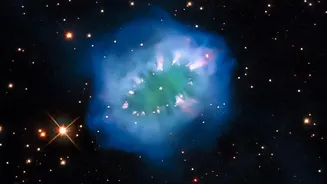
The ‘Eye of God’ in Unprecedented Detail
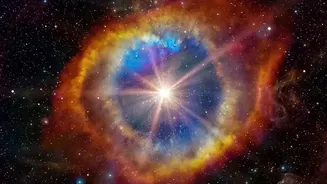
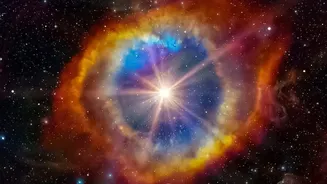
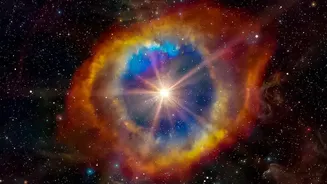
If you’ve ever glanced through a book of space photography, you’ve likely seen the Helix Nebula. Often called the “Eye of God” for its striking resemblance to a colossal eye staring across the cosmos, it’s one of the closest and most famous planetary
nebulae to Earth. Located about 650 light-years away in the constellation Aquarius, it's the glowing, expanding shell of gas shed by a dying star. For centuries, astronomers have studied it to understand what happens when a star exhausts its fuel. But Webb’s new image, captured with its powerful near-infrared camera, cuts through the ethereal haze seen by other telescopes and reveals the nebula's intricate structure with shocking clarity. It’s like we’ve gone from a watercolor painting to a high-resolution photograph, finally seeing the fine print of a star’s last will and testament.
A Universe of Tiny Comets
The most startling feature brought into focus by Webb are thousands of so-called “cometary knots”—dense, tadpole-shaped clumps of gas and dust that, until now, have remained mysterious. These aren’t comets in the traditional sense, but they look the part, with glowing heads and tails stretching for billions of miles. Each knot is immense, often twice the size of our entire solar system, and contains about the same mass as Earth. Webb's image reveals these knots are formed as blistering hot, fast-moving winds from the central dying star slam into cooler, slower gas that was ejected thousands of years earlier. This cosmic collision fragments the gas into these dense droplets, which are then sculpted by the star's intense radiation. Seeing this process in such detail helps explain how dying stars seed the universe with the raw materials for future stars and planets.
A Glimpse into Our Sun’s Future
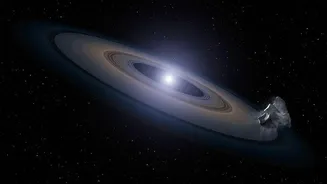
The reason the Helix Nebula holds such fascination is that it provides a direct preview of our own Sun's fate in about five billion years. Stars like our Sun don't die in massive supernova explosions. Instead, after they burn through their hydrogen fuel, they swell into red giants, and then gently puff their outer layers into space. The material drifts outward, forming a magnificent, glowing cloud—a planetary nebula. At the center, the star's incredibly hot, dense core, known as a white dwarf, remains. This core radiates intense energy, lighting up the expanding gas shells and creating the beautiful spectacle we see. The new Webb image shows this process in stages: the hottest gas glows blue closest to the star, while cooler molecular gas further out appears yellow and red. It is a stunning, step-by-step guide to the elegant end that awaits our star.
Why Webb's Infrared Vision is Key
Previous images from telescopes like Hubble have shown the Helix Nebula's ghostly beauty, but Webb sees the universe in a different light—infrared. This allows it to peer through the layers of gas and dust that can obscure details from visible-light observatories. Webb’s NIRCam (Near-Infrared Camera) is perfectly suited to pick up the signatures of molecular hydrogen and other elements in the cooler, denser regions of the nebula. This capability is what finally allowed scientists to resolve the cometary knots with such precision and understand the sharp transition from the hot, ionized inner regions to the cooler, dust-forming outer edges. Essentially, Webb can see the architecture of the nebula, not just its glowing facade. This ability to dissect the structure provides crucial data on how a star’s final act plays out, moment by moment.