




What is an Ice Stupa?
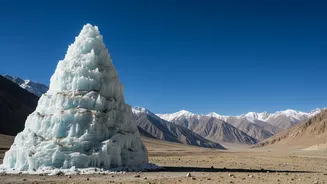
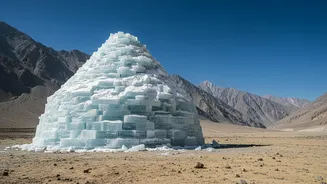
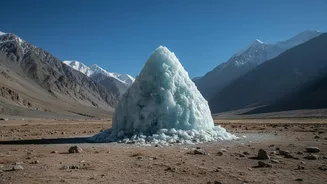
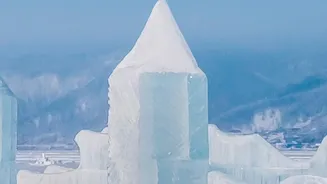
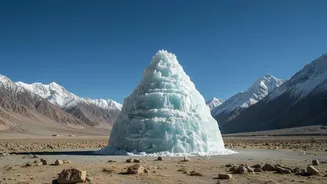
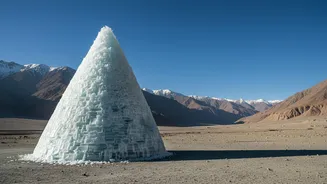
An ice stupa is a man-made glacier, conical in shape, designed to store winter water that would otherwise flow away unused. Named for their resemblance to traditional Buddhist monuments, these towering ice cones are built during the harsh winter months.
The concept was pioneered by engineer and innovator Sonam Wangchuk around 2013 as a direct response to the growing water crisis affecting agriculture in the region. Unlike earlier attempts at creating artificial glaciers, which were often horizontal and melted too quickly, the vertical stupa shape is a masterstroke of design. The first prototype, built in 2014, stood six metres tall and successfully stored 150,000 litres of water, proving the concept's viability.
The Simple Science of Conical Ice
The genius of the ice stupa lies in its geometry and use of gravity. The process begins in winter, when a pipeline is laid from a higher-altitude stream down to a village. The natural water pressure generated by the height difference forces the water up through a vertical pipe, from which it sprays out like a fountain. In the sub-zero Ladakhi air, this fine mist freezes as it falls, gradually forming a massive cone of ice. This conical shape is crucial; it presents the minimum possible surface area to the direct sun. As a result, the ice melts very slowly in the spring, releasing water gradually from April to June—precisely when farmers need it most for sowing their crops like barley and apples. This system requires no pumps, electricity, or complex machinery to operate.
Addressing a Critical Climate Challenge
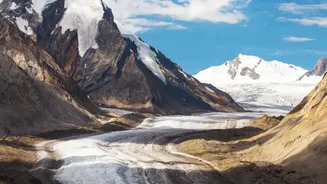
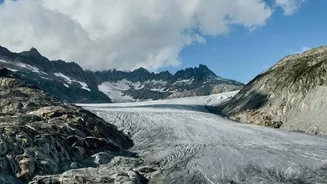
Ladakh's farmers, who make up about 80% of the population, have always depended on glacial meltwater for irrigation. However, climate change has disrupted this ancient cycle. Glaciers are receding to higher altitudes, and winter snows are less predictable. This creates a critical gap in the spring; natural glacial melt now often arrives too late for the planting season, threatening food security and livelihoods. The ice stupas are designed to bridge this exact gap. By storing winter water and releasing it during the crucial dry spell, they provide a vital resource that ensures crops can be planted on time. A single large stupa can hold millions of litres of water, enough to irrigate dozens of acres of land.
A Community-Powered Blueprint
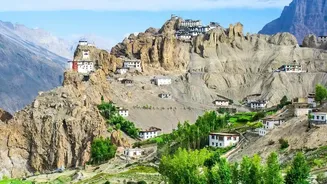
The success of the ice stupa is not just technological, but social. The projects are deeply rooted in community participation, building on indigenous knowledge of water management. Sonam Wangchuk and his organization, the Students' Educational and Cultural Movement of Ladakh (SECMOL), made local involvement a core principle. To encourage adoption and make the laborious construction process engaging, they even initiated an Ice Stupa Competition between villages. This has fostered a sense of ownership and turned a climate adaptation strategy into a source of community pride. The projects are cost-effective, with one estimate suggesting the water is delivered at a fraction of the cost of government-built reservoirs. This combination of low cost, simple technology, and community management is what makes it a sustainable blueprint.
From Ladakh to the World
The powerful simplicity of the ice stupa has garnered global attention. Since the first prototypes, dozens of stupas have been built across Ladakh, and the idea is spreading to other mountain regions facing similar challenges. Projects inspired by or directly collaborating with the Ladakhi team have been initiated in other parts of the Himalayas, the Swiss Alps, and even the Chilean Andes. While not a magic bullet for the climate crisis, the stupas are a powerful tool for adaptation. They represent a model where local communities, using accessible technology and an understanding of their environment, can build resilience against a changing climate. The initiative has also led to the creation of the Himalayan Institute of Alternatives, Ladakh (HIAL), dedicated to finding and scaling solutions for mountain communities worldwide.