
A New Window to Cosmic Dawn
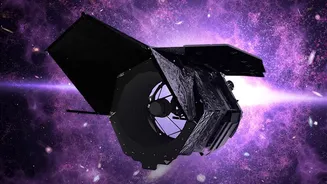
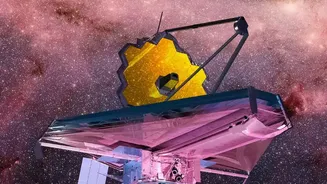
The latest revolution in our understanding of the universe comes from the James Webb Space Telescope (JWST). Unlike its predecessors, Webb is designed to see the cosmos in infrared light. This is crucial because, as the universe expands, light from the most
distant objects gets stretched out, shifting it towards the red end of the spectrum. This allows Webb to pierce through the cosmic dust and look back in time, capturing light that has been travelling for over 13 billion years. It’s like having a time machine that can witness the universe when it was just a few hundred million years old, a period previously shrouded in mystery known as the cosmic dark ages. These new, breathtaking images are providing the first clear views of the earliest galaxies taking shape.
Galaxies That Grew Up Too Fast
For decades, the standard model of cosmology predicted that the first galaxies would be small, clumpy, and chaotic. The universe was young, and it should have taken billions of years for gravity to pull together enough gas and stars to form the grand, structured galaxies we see today. However, Webb’s observations are showing something startlingly different. Astronomers are finding galaxies in the early universe that are far more massive and mature than expected. Some of these galaxies, seen as they were just a billion years after the Big Bang, are already rich in chemical elements, or 'metals', that should have taken much longer to produce. Others show organized, spinning discs of stars at their core, a sign of a settled, grown-up galaxy that astronomers thought was impossible so early on. This suggests the universe was in a 'huge hurry to grow up'.
The Chicken-and-Egg Problem of Black Holes
At the center of most large galaxies, including our own Milky Way, lies a supermassive black hole. A long-standing question has been which came first: the galaxy or its black hole? The prevailing theory was that stars formed first, and some later collapsed into black holes that gradually grew over time. Yet, Webb is discovering a surprising population of massive black holes in the first billion years of the universe, some of which appear to be millions or even billions of times the mass of our sun. The size of these ancient black holes is hard to explain with standard growth models. In some cases, the black hole's mass is a significant fraction of, or even greater than, the mass of all the stars in its host galaxy. This has led to a paradigm shift, with growing evidence that some massive black holes may have formed first, acting as seeds around which the first galaxies then grew.
Solving the 'Little Red Dots' Mystery
One of the most intriguing puzzles presented by Webb's data is the appearance of numerous 'little red dots' in images of the distant universe. These objects are extremely old and faint, but their sheer number has been a mystery. Recent studies are converging on an explanation: these dots may be a glimpse of a brief, intense phase in cosmic history. They are thought to be extremely active, growing supermassive black holes shrouded in dense clouds of gas and dust. This intense, ravenous growth phase could explain how black holes got so big, so fast. The theory is that as these black holes feed, they eventually blow away their dusty cocoons, evolving into the more recognizable galaxies we see in the later universe. This provides a potential link between the unexpectedly large black holes and the mature galaxies found at cosmic dawn.