



The Challenge of Seeing the Unseen
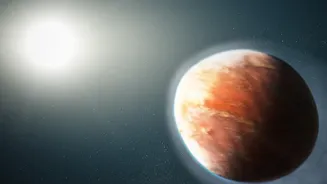
Studying exoplanets, which are planets orbiting other stars, is incredibly difficult. They are unimaginably far away and trillions of times fainter than their parent stars. Directly imaging these worlds is usually impossible. Instead, astronomers get
creative by studying the starlight that interacts with the planet. The key to understanding a planet's potential for life lies in its atmosphere. If we can figure out what gases make up its sky—like oxygen, methane, or the most coveted prize, water—we can begin to understand its nature. Before JWST, attempts to do this for smaller planets were often frustrated by hazy or cloudy atmospheres that blocked the view, leaving scientists with little information.
Webb’s Secret Weapon: Infrared Vision
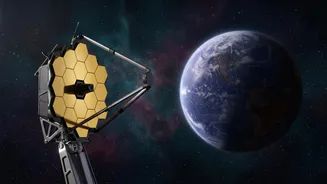
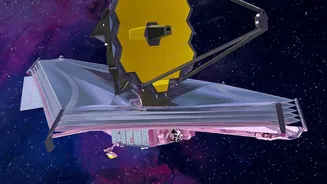
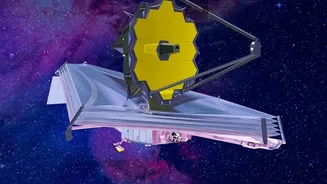
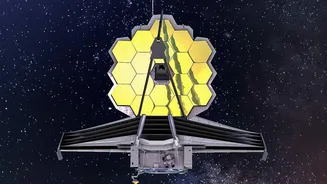
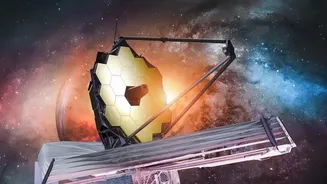
This is where the James Webb Space Telescope’s technological prowess comes into play. Webb is designed to see the universe in infrared light, which is invisible to the human eye but crucial for astronomy. This infrared vision allows it to peer through the cosmic dust that can obscure visible light. More importantly, molecules in a planet's atmosphere, including water, absorb specific wavelengths of infrared light. Each molecule has a unique “fingerprint.” By capturing this light, Webb’s instruments can identify which molecules are present. Its powerful suite of spectrographs, including the Near-Infrared Spectrograph (NIRSpec) and Mid-Infrared Instrument (MIRI), were specifically built for this task.
The Science of Starlight and Shadows
The primary technique Webb uses is called transit spectroscopy. It works by watching an exoplanet as it passes in front of its host star from our perspective—an event called a 'transit.' As the planet transits, a tiny fraction of the starlight filters through the planet's atmosphere. While the planet itself blocks a lot of light, its atmosphere acts like a subtle filter. The gases in the atmosphere absorb very specific colours, or wavelengths, of the starlight. By measuring the starlight before, during, and after the transit, astronomers can calculate exactly which wavelengths were absorbed by the atmosphere. This creates a dataset called a transmission spectrum.
Decoding the Water Signature
A transmission spectrum is essentially a graph showing how much light was blocked at each wavelength. If there is water vapour in the exoplanet's atmosphere, it will absorb infrared light at very specific, well-known wavelengths. This absorption creates a distinctive pattern of dips in the spectrum. When scientists see this specific pattern, they can confidently confirm the presence of water. For example, JWST's observations of the exoplanet WASP-96 b provided a textbook example of this, showing a clear and unambiguous signature of water vapour in its atmosphere. The telescope's instruments, like NIRSpec and MIRI, are so sensitive they can detect not just water, but even different isotopes like 'semi-heavy water', which can provide clues about how and where the planet formed.
From Data to Groundbreaking Discoveries
This technique has already yielded remarkable results. Since beginning its science operations, JWST has confirmed water in the atmospheres of several exoplanets, from hot gas giants to smaller, rocky worlds. For instance, recent measurements of the PDS 70 system detected water vapour in the inner disk where rocky planets like Earth are thought to form, suggesting that these worlds could have water available to them from the very beginning. Each detection helps astronomers build a clearer picture of planetary formation and evolution across the galaxy. While finding water vapour doesn't automatically mean finding life, it is a critical first step in identifying worlds that might have the right conditions to support it. The presence of water is considered essential for life as we know it.