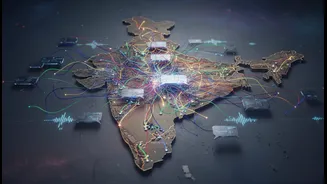









The AI Gold Rush in Indian Tongues
The global AI revolution has largely spoken English, but the next frontier of growth lies in catering to the hundreds of millions of internet users in India who communicate in other languages. This has spurred a gold rush, with both global tech giants
and domestic startups racing to develop Large Language Models (LLMs) for India's 22 official languages and countless dialects. Government initiatives like the IndiaAI Mission and Bhashini are pouring resources into this effort, aiming to create a sovereign AI ecosystem that can power everything from public services to e-commerce for a truly multilingual nation. The goal is to ensure that as AI becomes integral to daily life, it doesn't widen the digital divide for those who don't speak English.
The Dialect Trap: Why One Size Fits None
A key reason global AI models falter in India is their inability to grasp the country's profound linguistic diversity. It's not enough to train a model on 'Hindi' or 'Tamil'; one must account for the vast differences in dialects, accents, and colloquialisms that change from one region to another. A recent benchmark test called 'Voice of India' revealed that even top global AI models struggle with real-world Indian speech, which often includes code-switching (mixing languages like Hinglish) and background noise. Initiatives like Project Vaani, a collaboration between Google and the Indian Institute of Science, are attempting to map this diversity by collecting speech data from every district in India, creating one of the largest datasets of Indian dialects ever. Without this granular understanding, AI models produce awkward, robotic, or simply incorrect outputs, failing to connect with users.
Navigating Sensitive Conversations
Beyond getting the language right, AI models must be carefully tested for their handling of 'sensitive tasks'. This includes providing information on critical topics like healthcare, finance, and legal matters, as well as discussing social and cultural issues. In the diverse Indian context, these topics are fraught with nuance. An AI trained on biased data can easily reinforce harmful stereotypes related to caste, gender, or religion, leading to discriminatory or offensive outcomes. Researchers are actively developing frameworks like IndiCASA and IndQA to specifically test for these biases and ensure cultural fluency. The Indian government has also mandated that developers building models under the IndiaAI Mission must prioritize stringent stress testing to mitigate these risks before deployment. Failure to do so not only risks user trust but can cause genuine harm.
Why Local Data Processing Matters
Effectively testing AI for dialects and sensitivities requires another crucial component: local data processing. Keeping and processing Indian data within India's borders is becoming a strategic imperative, driven by regulations like the Digital Personal Data Protection Act. For AI development, this is not just about compliance. Local data centers reduce latency, allowing for the real-time processing needed for sophisticated voice AI and other applications. More importantly, it ensures data sovereignty, giving India control over its digital infrastructure and reducing reliance on foreign cloud giants. This local control enables the development of more ethical, culturally relevant, and legally compliant AI models that are trained on diverse, locally relevant datasets. A recent survey showed that 75% of Indian businesses are already aligning their data strategy with localization to prepare for an AI-driven future.
The Real Cost of Cutting Corners
For companies building Indian-language AI, skipping the rigorous, expensive process of testing across dialects and sensitive tasks might seem like a tempting shortcut. However, it's a false economy. Releasing a model that fails to understand its users or, worse, offends them, is a recipe for market rejection and reputational damage. The performance gap between India-focused models and their global counterparts is already evident, with local systems often showing significantly higher accuracy on Indian languages. As AI becomes more integrated into critical sectors, the tolerance for error will be low. The companies that succeed will be those that recognize that building for India requires more than just translation; it requires a deep, ground-up understanding of its people, languages, and cultures.