


A Cosmic Chemical Factory
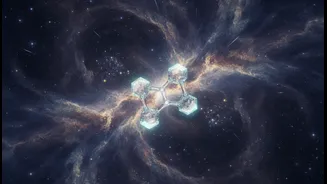
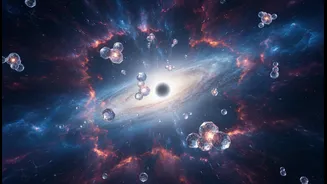
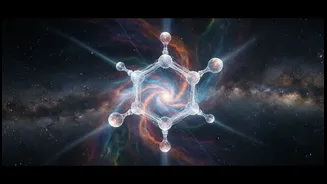
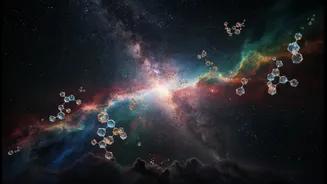
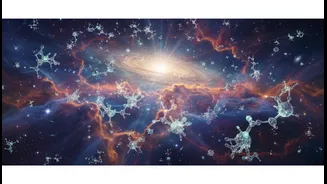
In a massive, turbulent cloud of gas and dust near the Milky Way's center, scientists have detected the clear signature of complex organic molecules. These aren't just simple compounds, but intricate carbon-based structures that are considered the essential
raw materials for life as we know it. One of the most recent and exciting finds is a sugar called erythrulose, a four-carbon molecule also found in raspberries. This marks the first time a true sugar has been identified in interstellar space. While scientists have found over 300 types of molecules in space before, the detection of a sugar is a significant leap forward. These molecules are called 'complex organic molecules' or COMs by astronomers, a category that includes alcohols, esters, and ethers which are fundamental for prebiotic chemistry.
The Location: A Star-Forming Nursery
The discovery was made in a region known as Sagittarius B2 (Sgr B2). This is not just any patch of sky; it is a giant molecular cloud, one of the largest and most dense in our galaxy, located just a few hundred light-years from the supermassive black hole, Sagittarius A*. Sgr B2 is a stellar nursery, a chaotic and energetic place where new stars are being born. The specific cloud where the sugar was found, named G+0.693-0.027, is known to be one of the richest reservoirs of complex molecules in the galaxy. This environment, filled with dust, gas, and radiation from young stars, provides the perfect, if chaotic, laboratory for complex chemistry to occur long before planets even begin to form.
How Scientists Played Detective
Detecting a specific molecule from thousands of light-years away is a monumental task. An international team of researchers, led by scientists from Spain's Center for Astrobiology, used powerful radio telescopes to make the discovery. Every molecule rotates and vibrates at a unique frequency, producing a distinctive pattern of radio waves, like a molecular fingerprint. The astronomers pointed their telescopes at the Sagittarius B2 cloud and meticulously analysed the faint radio signals coming from it. By matching the observed signal patterns against the known laboratory signature of erythrulose, they could confirm the sugar's presence with confidence.
Why This is a Big Deal
Finding these molecules doesn't mean we've found alien life. What it does suggest, however, is that the fundamental building blocks of life might be common throughout the universe. Sugars are vital for life on Earth; they form the backbone of our genetic material, DNA and RNA, and are crucial for metabolic processes that provide energy to cells. The discovery that a sugar like erythrulose can form naturally in the vastness of interstellar space supports a fascinating theory: that the raw ingredients for life didn't originate on a primitive Earth. Instead, they may have been delivered to young planets like ours by comets and meteorites that were seeded with these complex molecules from their birth clouds. This find makes the potential for life to exist elsewhere in the galaxy just a little bit more likely.
What Comes Next in the Search
This discovery opens a new frontier in the field of astrobiology. Scientists are now eager to search for even more complex sugars and other molecules that are direct precursors to RNA, the likely predecessor to DNA. Powerful new tools like the James Webb Space Telescope are providing unprecedented views into these dense, dusty regions of space that were previously hidden from us. By studying the chemical inventory of these stellar nurseries, astronomers hope to understand just how far prebiotic chemistry can progress in interstellar space before planets are even formed. Each new molecule identified adds another piece to the puzzle of how a lifeless cosmos could eventually give rise to biology.