





The Deluge of Data
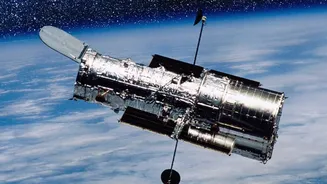
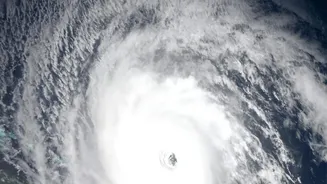
Modern scientific instruments, from the James Webb Space Telescope to Earth-observing satellites, generate an astronomical amount of data. NASA's archives hold petabytes of information, a scale far too vast for human scientists to manually sift through.
This is where AI steps in. Machine learning algorithms can scan decades of complex mission telemetry and observational data in a fraction of the time, spotting patterns and anomalies that human eyes might miss. By automating the heavy lifting of data analysis, AI frees up researchers to focus on interpretation, hypothesis, and the next big questions. NASA's recent participation in the federal Genesis Mission initiative underscores this strategy, aiming to apply advanced AI models across 150 petabytes of space data to shorten analysis times from years to days.
AI as a Robotic Co-Pilot
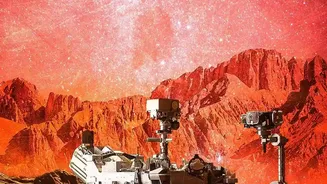
On distant worlds like Mars, communication delays make direct human control impossible. A signal from Earth can take over 20 minutes to reach a rover, making real-time navigation a non-starter. This is why rovers like Perseverance rely heavily on AI for autonomous operation. The rover uses its cameras and onboard computer to analyze the terrain, identify hazards like rocks and steep slopes, and chart its own course without human intervention. Beyond just driving, AI also helps guide the scientific mission. The Curiosity rover uses an AI algorithm to select its own rock targets for laser analysis, optimizing the chances of a significant find. This level of autonomy is crucial, allowing spacecraft to make intelligent decisions on the fly and continue their work even when out of contact with Earth.
Discovering the Unseen
AI is not just making existing science faster; it's enabling entirely new forms of discovery. NASA's ExoMiner, a deep learning system, analyzed data from the Kepler Space Telescope and successfully identified 301 new exoplanets that had previously been overlooked. Similarly, AI models trained on vast image libraries can now predict solar flares or identify gravitational waves from cosmic events like colliding black holes. Foundation models, like the Prithvi geospatial model developed with IBM, can be trained on enormous datasets and then adapted for specific scientific tasks, from monitoring natural disasters to tracking climate patterns. These systems learn to recognize patterns that define a phenomenon, allowing them to find it in new data with superhuman efficiency and accuracy.
The Future: An Autonomous Frontier
The vision for AI in space extends far beyond data analysis. The future involves AI-driven systems that can manage and maintain spacecraft with little to no human oversight. This includes autonomous maintenance, real-time repairs, and optimized resource management for deep-space missions where human assistance is impossible. NASA is testing next-generation, radiation-hardened computer chips that could give spacecraft the ability to 'think' for themselves. This could lead to missions that can adapt to unexpected challenges, prioritize scientific targets autonomously, and even manage complex tasks like on-orbit satellite servicing and assembly, pushing our exploratory capabilities further into the solar system and beyond.