



The Conventional Way: Landing on Legs
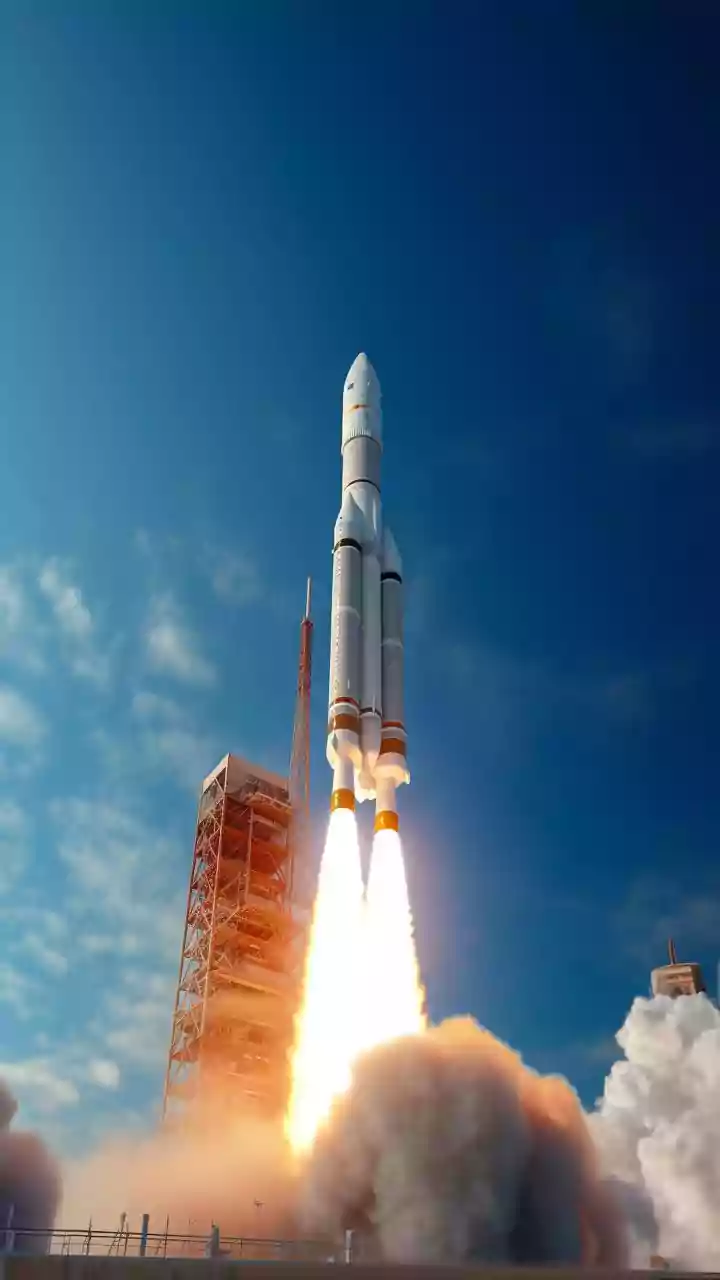
For years, the world has marvelled at SpaceX's Falcon 9 boosters landing themselves upright on ground pads or drone ships at sea. This is achieved with deployable landing legs and a complex series of engine burns to slow the booster for a soft touchdown.
While revolutionary, this approach has a key drawback: the legs, their deployment mechanisms, and the extra fuel needed for landing are dead weight. Every kilogram of landing hardware is a kilogram that can't be payload, which directly impacts the rocket's efficiency and cost-effectiveness. This hardware must be carried all the way to space and back, only to be used for the final few seconds of the flight.
A Radical New Plan: 'Mechazilla'
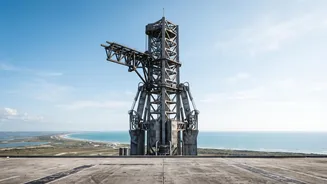
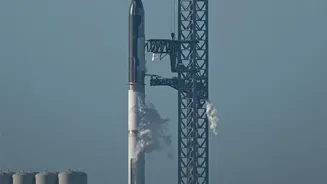
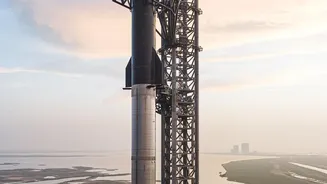
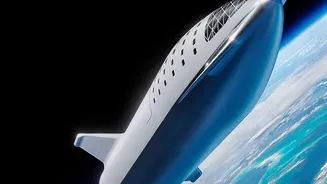
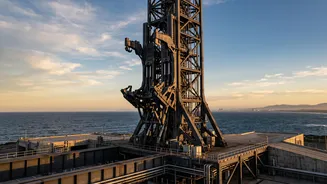
For its next-generation Starship system, SpaceX is throwing out the landing legs entirely. Instead, it has built a massive, 146-meter launch and integration tower nicknamed 'Mechazilla'. Attached to this tower is a set of enormous, powerful arms, often called 'the chopsticks', which move up and down the structure. The plan is to use these arms to literally pluck both the Super Heavy booster and, eventually, the Starship upper stage out of the air as they return for landing. After launching, the booster separates and flies back to the launch site, hovers next to the tower, and allows the arms to close around it, securing it at strong points near its grid fins.
The Great Hardware Trade-Off
This strategy is a classic engineering trade-off: remove complexity from the vehicle and move it to the ground. The rocket becomes simpler and significantly lighter by shedding its landing legs and all associated systems. That mass savings can be used to carry more lucrative cargo, more fuel for ambitious missions, or more crew. In exchange, the ground infrastructure becomes incredibly complex. The tower and its arms must be immensely strong, capable of absorbing the huge dynamic loads of a returning rocket, and feature sophisticated sensor, hydraulic, and control systems to ensure a perfect catch with centimetre-level precision. While the rocket has to be mass-efficient to fly, the ground system has no such limitation and can be 'overbuilt' for strength and reliability.
The Need for Speed and Savings
The primary driver behind this seemingly wild idea is rapid reusability. SpaceX's ultimate goal is not just to reuse rockets, but to do so with airline-like efficiency, potentially launching the same vehicle multiple times a day. Catching a booster with the tower means it is already at the launch site, perfectly positioned to be placed back on the launch mount, stacked with a new upper stage, and refuelled for its next flight within hours. This eliminates the time-consuming process of retrieving a booster from a landing pad or a drone ship at sea, transporting it, and then preparing it for the next launch. This high launch cadence is essential for SpaceX's long-term ambitions, like building a city on Mars, which would require numerous tanker flights in a short window to refuel a Mars-bound Starship in orbit.
An Audacious, High-Stakes Gamble
The tower-catch strategy is not without immense risk. The precision required for the manoeuvre is staggering, and a failure could be catastrophic, potentially destroying not just the returning rocket but also the entire launch tower and ground infrastructure. During the first successful booster catch in October 2024, engineers later revealed the vehicle was just one second away from an erroneous abort command that would have sent it crashing into the ground beside the tower. Any slight miscalculation, system glitch, or unexpected wind gust could have disastrous consequences. However, SpaceX has decided that the potential rewards of a lighter, more efficient, and rapidly reusable launch system are worth the high-stakes engineering challenge.