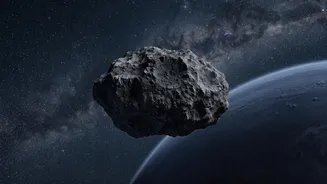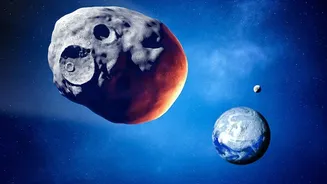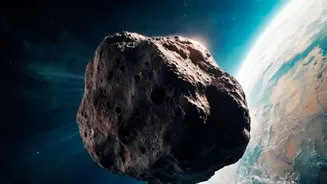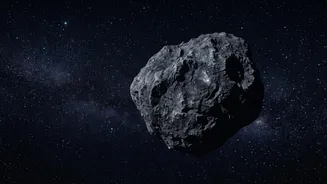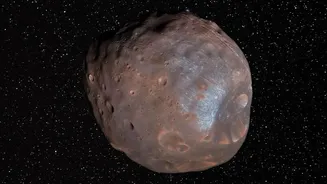






It turns out Earth’s relationship with the Moon isn't entirely exclusive. Our planet occasionally hosts tiny, temporary companions, and the latest visitor is 2026 QQ8, a small asteroid caught in a gravitational dance that gives us a new 'mini-moon'.
What Exactly Is a Mini-Moon?
While
our large, permanent Moon has been a constant companion for billions of years, a 'mini-moon' is the informal name for a much smaller space rock that Earth’s gravity temporarily captures. These objects, technically called Temporarily Captured Objects (TCOs), are usually asteroids that, due to a chance combination of speed and trajectory, get pulled into a looping orbit around our planet. Unlike our main Moon, their stay is brief. A typical mini-moon might orbit for a few months before the gravitational pulls of the Sun and other planets sling it back out into its own path around the sun. Simulations suggest that at any given time, Earth is likely hosting at least one of these meter-sized objects, but their small size and faintness make them incredibly difficult to detect.
Meet Our Newest Companion: 2026 QQ8
The latest addition to Earth's temporary satellite collection is 2026 QQ8. First spotted by Hungarian astronomer Krisztián Sárneczky in August 2026, this object is estimated to be tiny, measuring only about two meters (roughly six feet) in diameter—comparable to the size of a large appliance or a compact car. Its small size initially created a debate among scientists, who had to perform careful observations to confirm it was a natural asteroid and not a piece of old space junk, like a discarded rocket booster. After several weeks of analysis, the International Astronomical Union's Minor Planet Center officially designated it as asteroid 2026 QQ8, confirming its natural origin.
The Delicate Dance of Gravitational Capture
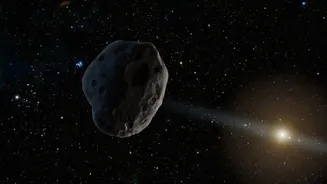
How does an asteroid become a mini-moon? Most of these objects originate in the main asteroid belt between Mars and Jupiter. Over millions of years, gravitational nudges can push them into orbits that bring them closer to Earth. If one of these Near-Earth Objects (NEOs) approaches our planet at a relatively low speed, it can be gently drawn in. The combined gravity of the Earth and Moon can perturb the asteroid's path just enough to pull it from its solar orbit into a temporary, and often chaotic, orbit around us. According to trajectory calculations, 2026 QQ8 was captured in April 2026 and is expected to remain in our vicinity until early December 2026 or January 2027, when it will escape Earth's gravity and resume its journey around the sun.
A Rare Scientific Opportunity
While mini-moons might be common, actually detecting and tracking one is rare and scientifically valuable. These objects serve as fantastic natural laboratories. Studying 2026 QQ8's looping path allows astronomers to test and refine their models of gravitational interactions in the Earth-Moon system. This helps improve the sky-survey systems that are designed to find potentially hazardous asteroids. Because they are already close to Earth and moving at low relative speeds, mini-moons are also considered prime targets for future robotic sample-return missions. They offer a chance to study asteroid material up close without the immense cost and time required to travel to the main asteroid belt.
Can You See the Mini-Moon?
Unfortunately, you won't be able to spot 2026 QQ8 with the naked eye or even a standard backyard telescope. Its incredibly small size and vast distance—currently about 1.5 times farther away than our permanent Moon—mean it is far too faint for casual observation. Even for professional astronomers with powerful instruments, it appears as just a dim point of light, requiring significant effort to track. While this cosmic visitor will remain unseen by most, its temporary presence reminds us that our corner of the solar system is a dynamic and ever-changing place, full of celestial objects passing by.