





The Foundation: Your Chair and Feet
Before you look at any accessory, start with your chair. The goal is to have your feet flat on the floor with your thighs roughly parallel to it. Your knees should be at about a 90-degree angle. If your feet are dangling, don't rush to buy a new chair;
use a sturdy box, a stack of books, or a dedicated footrest to support them. This simple change reduces pressure on your lower back. Then, sit all the way back in your chair so your lower back is supported. If there's a gap, roll up a towel or use a small cushion to provide lumbar support. These two tweaks stabilize your entire posture without costing a rupee.
At Eye Level: The Monitor's Position
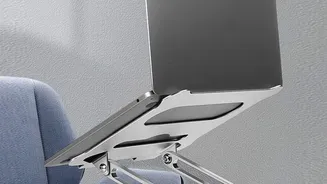
One of the biggest culprits of neck and shoulder pain is a poorly positioned monitor. Most people look down at their screens, especially on a laptop, forcing the neck into an unnatural forward tilt. The top of your monitor should be at or just slightly below your eye level, and about an arm's length away. You shouldn't have to tilt your head up or down to see the middle of the screen. The fix is easy: stack old textbooks or reams of paper under your monitor or laptop stand until it reaches the correct height. This single adjustment can immediately relieve chronic strain on your neck and upper back.
Within Reach: Keyboard and Mouse Placement
Your keyboard and mouse should be positioned so that your elbows are bent at a roughly 90 to 110-degree angle, with your arms relaxed at your sides. You shouldn't have to hunch your shoulders or reach forward to type. Your wrists should be straight, not bent up or down. If your desk is too high, you can raise your chair (using a footrest if needed) to get the right arm angle. If the keyboard is still too high, a keyboard tray can help, but first try the chair adjustment. Keep your most-used items, like your mouse and phone, close to your keyboard to avoid constant reaching, which strains the shoulder over time.
Ergonomics Is a Behaviour, Not a Purchase
Even the most perfectly arranged, expensive setup will fail if you remain static for hours. Ergonomics is not just about furniture; it's about how you use your space. The most crucial ergonomic habit is to incorporate regular movement. Sitting for prolonged periods reduces blood flow and causes muscle fatigue, regardless of your posture. Set a timer to stand up, stretch, and walk around for a few minutes every 30 to 45 minutes. These 'micro-breaks' allow your muscles to reset and prevent stiffness from setting in. A walk to get a glass of water or simply stretching your arms overhead can make a significant difference in your energy levels and reduce the risk of musculoskeletal issues.