





The Universe's Dark Ages
Imagine a time before stars and galaxies, when the entire universe was filled with a dense, neutral hydrogen gas. This period, beginning about 380,000 years after the Big Bang, is known as the cosmic "Dark Ages." It wasn't just dark because there were
no stars; it was fundamentally opaque. Any high-energy ultraviolet (UV) light that might have existed was instantly absorbed by the surrounding hydrogen fog, unable to travel across space. This makes studying the era incredibly challenging. How did the universe transition from this murky state to the transparent, star-filled cosmos we see today? Scientists have long theorized that the answer lies in the first stars and galaxies, but direct evidence has been elusive.
An 'Impossible' Glimmer of Light
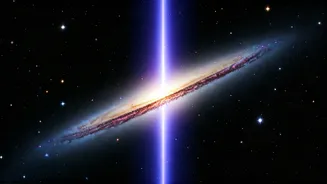
In a remarkable breakthrough, astronomers using the Hubble Space Telescope, supported by data from the James Webb Space Telescope (JWST), have detected the impossible: ultraviolet light from a galaxy named MXDFz4.4, which existed just 1.4 billion years after the Big Bang. Until now, researchers believed the cosmic fog would have been too thick to allow such a direct view of ionizing light from this era. This galaxy existed at the tail end of the "Epoch of Reionization," the transformative period when the fog was actively being cleared. This discovery provides the first direct, detailed look at one of the very mechanisms that made the universe transparent.
Why UV Light Is the Key
Ultraviolet light is the calling card of young, massive, and incredibly hot stars. It's a form of ionizing radiation, meaning it carries enough energy to strip electrons from hydrogen atoms, turning the opaque neutral gas into a transparent ionized plasma. For years, astronomers have debated what provided enough of this light to reionize the entire universe. The prevailing theory was that the first generations of stars and galaxies were responsible, gradually creating bubbles of clear space that grew and merged until the cosmic fog lifted completely. Finding UV light actually escaping a galaxy from this era is like catching the culprit red-handed. The light from MXDFz4.4, though it was emitted as UV, has been stretched by the expansion of the universe over 12 billion years, allowing telescopes like Hubble to detect it as visible light today.
A Small Galaxy with a Big Punch
What makes MXDFz4.4 so special is its unusual structure. The galaxy is tiny, about 100 times smaller than our own Milky Way, but it's an incredible stellar nursery, forming stars about 10 times faster. These young, massive stars are crammed together in a very small space. This intense concentration of star formation appears to have been powerful enough to blast holes in the gas and dust within the galaxy itself, creating escape channels for the powerful UV light. According to researchers, this suggests that countless small, efficient galaxies like this one, rather than just a few giant ones, were likely the primary drivers behind reionizing the cosmos. It's a classic story of the little guys teaming up to change the world—or in this case, the universe.
A New Chapter in Cosmic History
This discovery does more than just confirm a long-held theory; it refines it. By combining Hubble's view with infrared data from the JWST, scientists can piece together the galaxy's star-formation history, confirming that recent, intense bursts of activity are responsible for its fog-clearing power. It provides a crucial, real-world example that can be used to fine-tune the complex computer simulations that model the early universe. This single observation has moved a key piece of the cosmic dawn puzzle from the realm of theory into the column of direct evidence, making one of the most mysterious chapters of space significantly less so.