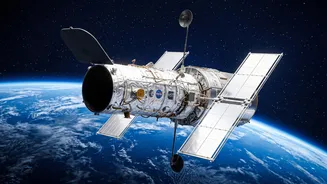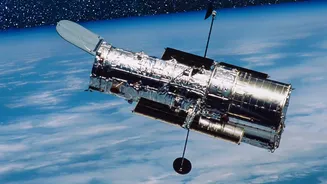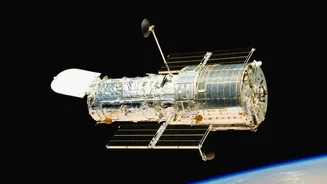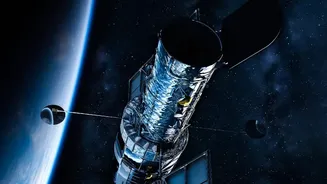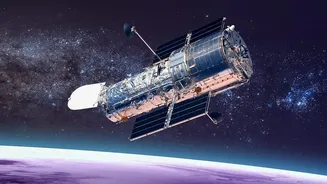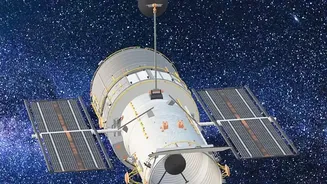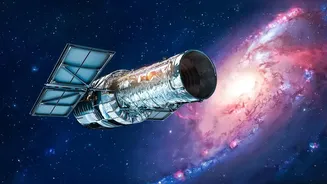





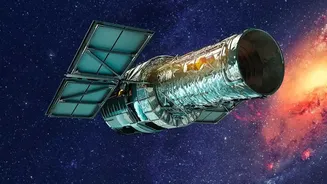
For over three decades, the Hubble Space Telescope has been humanity’s eye into the cosmos, but its orbit is slowly decaying. Now, a recent call for ideas from NASA could give the iconic observatory a new lease on life.
The Inevitable Descent
Like all satellites in low Earth
orbit, Hubble is subject to atmospheric drag. Even in the thin atmosphere hundreds of kilometers up, microscopic particles create a tiny amount of friction, causing the telescope to gradually lose altitude. Since the final Space Shuttle servicing mission in 2009, Hubble—which has no onboard propulsion—has been in a slow, steady descent. NASA projects that without intervention, the telescope will likely re-enter Earth's atmosphere sometime between 2033 and 2035. This would bring a fiery end to one of the most productive scientific instruments ever built, making the search for a solution increasingly urgent.
A Call for Creative Solutions
In late October 2026, NASA officially issued a Request for Information (RFI), opening the door for private companies to propose ways to save the aging observatory. This move signals a significant shift, turning to the burgeoning commercial space industry for solutions that were once the sole domain of government agencies. The RFI isn't a formal contract but rather a market survey to understand what's possible, how much it might cost, and who could do it. NASA made it clear it is exploring the full breadth of possibilities, from simple to complex, to ensure Hubble's story doesn't end with an uncontrolled reentry.
To Boost or To Service?
The proposals requested by NASA fall into three main categories. The simplest option is an orbital reboost: a mission to rendezvous with Hubble and push it into a higher, more stable orbit, potentially adding 15 to 20 years to its life. A more ambitious idea is a full servicing mission, which could not only raise the orbit but also upgrade scientific instruments or replace aging components, similar to the five crewed missions performed by Space Shuttle astronauts. The final option is for a controlled de-orbit, ensuring the telescope's safe disposal over a remote part of the ocean at the end of its scientific life.
The Commercial Contenders
This RFI follows a 2022 unfunded study between NASA and SpaceX to investigate the feasibility of using a Dragon spacecraft for a reboost mission, an idea championed by the Polaris Program, led by billionaire Jared Isaacman. While that initial study explored a specific crewed concept, the new RFI is broader, inviting ideas from the entire industry. This could involve robotic missions, which might be seen as lower risk than sending astronauts. Companies will need to detail their plans for launch vehicles, spacecraft, and rendezvous procedures by the November 30 deadline, giving NASA a clear picture of the commercial landscape.
A New Model For Space Assets
Whatever path NASA chooses, the effort to save Hubble could set a major precedent. As more complex and valuable assets are placed in orbit, the question of how to maintain, upgrade, or safely retire them becomes critical. Successfully partnering with a commercial company to extend Hubble's mission would demonstrate a new, more sustainable model for space operations. It would prove that legacy hardware doesn't have to be disposable and that innovative partnerships can help preserve our most important scientific tools for future generations to use and enjoy. The responses to this RFI may not only decide Hubble's fate but also shape the future of in_space servicing.