




A Panoramic View of the Cosmos
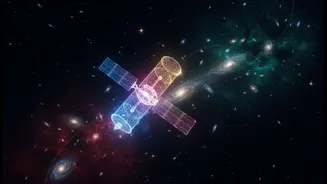
Imagine trying to study an entire forest by looking through a straw. That has been one of the challenges for previous space telescopes, which captured stunningly deep but narrow views of the universe. The Nancy Grace Roman Space Telescope, named after
NASA's first chief astronomer, changes the game completely. While it has the same size primary mirror as the Hubble Space Telescope, its Wide Field Instrument gives it a field of view at least 100 times larger. This means Roman can map vast stretches of the sky with the same high resolution that took Hubble years to achieve. In fact, scientists estimate that one month of Roman's observation time will be equivalent to a century on Hubble. Set to launch on a SpaceX Falcon Heavy rocket, this powerful observatory is not just an upgrade; it’s a leap forward in our ability to survey the universe efficiently. Its five-year primary mission is expected to generate a staggering 20,000 terabytes of data, creating an unprecedented archive for astronomers to explore.
The Dark Universe Detective
About 95% of the universe is made of mysterious substances we can't see: dark matter and dark energy. Dark matter provides the invisible scaffolding for galaxies, while dark energy is the enigmatic force causing the universe's expansion to speed up. Roman is uniquely equipped to investigate both. It will use a technique called weak gravitational lensing, measuring how the light from distant galaxies is subtly distorted by the gravity of dark matter clumps. By mapping these distortions across millions of galaxies, Roman will create the most detailed map of dark matter ever produced, helping scientists understand its nature and how it has shaped cosmic structures. To probe dark energy, the telescope will conduct massive surveys of galaxies and distant exploding stars called supernovae. By measuring their distances and how fast they are moving away from us with incredible precision, astronomers can trace the expansion history of the universe and test whether our understanding of gravity is complete.
A Census of Alien Worlds
Are we alone? The search for planets beyond our solar system, or exoplanets, gets a massive boost from Roman. Astronomers predict the mission could find as many as 100,000 new exoplanets, potentially doubling the number of known worlds in a single mission. Roman will employ two main techniques. The first is the transit method, where it watches for the tiny, periodic dimming of a star's light as a planet passes in front of it. The second, and a major focus for Roman, is gravitational microlensing. This phenomenon, predicted by Einstein, occurs when a star and its planets drift in front of a more distant star, briefly magnifying its light like a cosmic lens. This method is sensitive enough to find planets with a wide range of sizes, including those with masses smaller than Earth, and even rogue planets that drift through space without a host star. This comprehensive planetary census will give us a much clearer picture of how common different types of solar systems are throughout our galaxy.
Mapping Cosmic History
Beyond its primary goals, Roman's power lies in its ability to conduct enormous surveys. Its High-Latitude Wide-Area Survey will create vast, three-dimensional maps of the universe, capturing the positions and distances of hundreds of millions of galaxies. This will allow astronomers to study how the largest structures in the universe, like galaxy clusters, formed and evolved over billions of years. Another program, the Galactic Plane Survey, will peer through the dusty heart of our own Milky Way, mapping an estimated 20 billion stars. This will provide new insights into our galaxy's structure and the star-formation process. By observing huge populations of galaxies instead of just a few individuals, Roman will provide the statistical power needed to test our most fundamental cosmological models. All the data collected will be made publicly available, ensuring that its discoveries can be analyzed by scientists around the world for decades to come.