



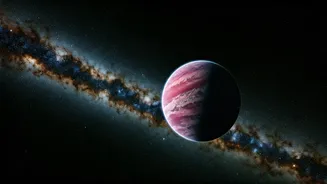


Meet a Super-Hot Super-Earth
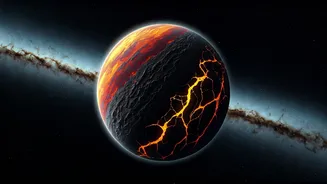
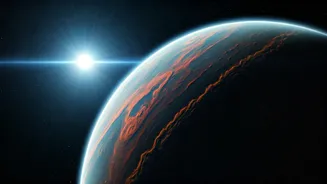
The planet in question is 55 Cancri e, a world about 41 light-years away that has fascinated astronomers for years. It's classified as a 'super-Earth,' meaning it's rocky like our own planet but significantly larger—nearly twice Earth's diameter. However,
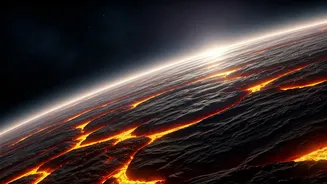
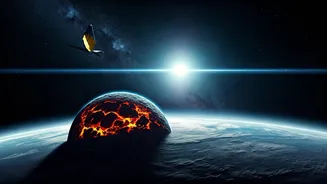
any resemblance ends there. This planet orbits its star at a blistering proximity, completing a full year in just 18 hours. This extreme closeness means its surface is likely a molten, bubbling ocean of magma. Because of this tight orbit, 55 Cancri e is also thought to be tidally locked, with one side perpetually facing the star's intense heat and the other cloaked in permanent darkness.
An Atmosphere That Shouldn't Exist
For a long time, the scientific consensus was that a planet like 55 Cancri e couldn't possibly hold onto a substantial atmosphere. The sheer heat and intense radiation from its nearby star should have stripped away any primordial gases millions of years ago. Previous observations with the Spitzer Space Telescope seemed to support this, suggesting a massive temperature difference between the day and night sides, which you'd expect from a bare rock world unable to circulate heat. The best guess was that any 'atmosphere' would just be a thin, fleeting shroud of vaporized rock. Scientists were preparing to study a glowing ember, but Webb delivered something far more complex.
Webb Detects the Unexpected
Using its powerful infrared instruments, Webb measured the thermal emission—the heat—coming from the planet. The results were startling. Instead of the 2,200 degrees Celsius expected for a bare rock dayside, the temperature was a comparatively cooler 1,500 degrees Celsius. This temperature difference is a strong clue. It suggests that energy is being distributed from the scorching dayside to the cooler nightside. The most likely explanation for this heat transfer is a substantial atmosphere, one rich in volatiles like carbon dioxide or carbon monoxide. This was the best evidence to date for a rocky planet's atmosphere outside our solar system.
A World With a Magma Ocean
So if the original atmosphere was blasted away, where did this new one come from? The leading theory is that it is a 'secondary atmosphere,' constantly being replenished from the planet's interior. Scientists believe the vast magma ocean isn't just molten rock; it's also full of dissolved gases. These gases are continuously bubbling out of the magma, feeding the atmosphere in a dynamic, planet-wide process. This interaction between the surface and the atmosphere is exactly the kind of process that helps scientists test and refine their models. The observation didn't fit the old theory, so a new, more interesting one had to be developed to explain the data.
Why This Lava World Matters
While 55 Cancri e is far too hot to be habitable, this discovery has huge implications for the search for life elsewhere. It proves that a rocky planet in an extreme environment can hold onto an atmosphere, expanding the range of worlds that might have them. This forces scientists to update their planetary models, which are essentially complex computer simulations used to predict what distant worlds might be like. By studying the strange case of 55 Cancri e, we get a better understanding of the interactions between a planet's interior, surface, and atmosphere. This knowledge is crucial for identifying which planets are the most promising candidates to search for signs of life in the future.