




The Planetary Neighborhood Watch
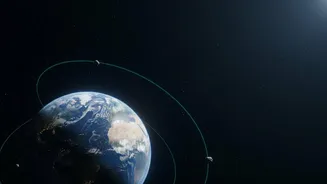
A Near-Earth Object (NEO) is an asteroid or comet whose orbit brings it within approximately 45 million kilometers of Earth's path around the Sun. While more than a hundred tons of tiny sand-sized particles bombard our atmosphere daily, it's the larger
objects that concern scientists. An asteroid just 50 meters wide could devastate a large urban area, similar to the 1908 Tunguska event that flattened over 2,000 square kilometers of forest in Siberia. A larger impact, like the one that led to the extinction of the dinosaurs, would be a civilization-ending event. Though statistically rare, such impacts are an inevitability over geological timescales. This potential for catastrophe is why global space agencies have made finding and cataloging these objects a top priority.
Eyes on the Sky
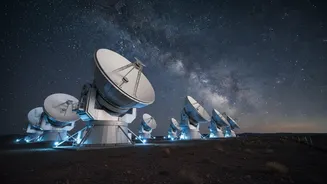
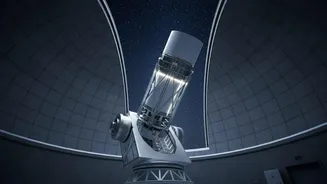
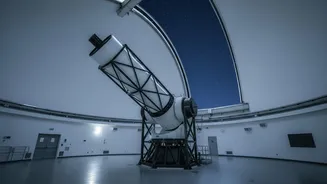
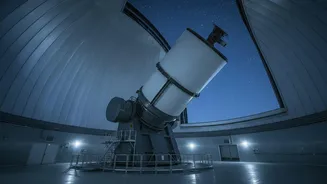
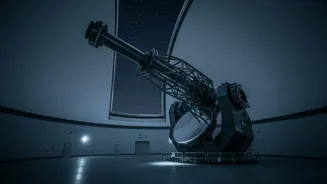
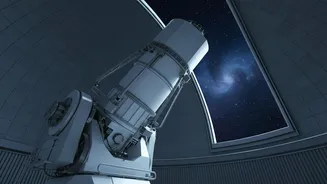
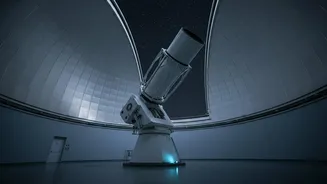
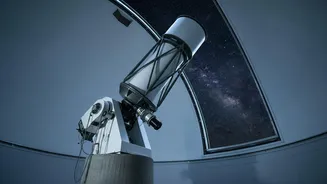
So how do you find a relatively small, dark rock hurtling through the blackness of space? Astronomers rely on a global network of survey telescopes that repeatedly image the same patches of sky. By comparing these images, specialized software can detect faint points of light that move against the fixed background of stars and galaxies. Projects like the Catalina Sky Survey and Pan-STARRS, primarily funded by NASA, have been instrumental in this search. Once a potential NEO is flagged, its position is sent to the Minor Planet Center, a global clearinghouse for these observations. From there, astronomers around the world perform follow-up observations to calculate the object's precise orbit, size, and composition. This data allows organizations like NASA’s Center for Near-Earth Object Studies (CNEOS) to predict its future path and determine if it poses any threat to Earth for the next century.
From Detection to Deflection
Simply knowing an asteroid is coming isn't enough; we need a plan to deal with it. This is where planetary defense transitions from observation to action. The most crucial factor is time. The earlier we detect a potential threat, the more options we have to deflect it. For this reason, NASA established the Planetary Defense Coordination Office (PDCO) in 2016 to coordinate these efforts. In a historic first, NASA's Double Asteroid Redirection Test (DART) mission in 2022 proved that we can alter the path of a celestial body. The DART spacecraft successfully slammed into the small asteroid Dimorphos, shortening its orbit around its larger companion, Didymos, by a remarkable 32 minutes—far exceeding the mission's success criteria. This demonstrated that a 'kinetic impactor' is a viable technique for nudging a dangerous asteroid off a collision course, provided we have years or decades of warning.
A Crucial Investment for Humanity
Unlike other natural disasters, an asteroid impact is a predictable and preventable catastrophe. This unique characteristic elevates planetary defense from a fascinating scientific pursuit to arguably the most crucial space mission for the long-term survival of our species. International collaboration is key, with organizations like the European Space Agency (ESA) developing its own 'Flyeye' telescopes and planning missions to rendezvous with asteroids. Upcoming projects like NASA's NEO Surveyor space telescope, scheduled to launch no earlier than 2027, will dramatically accelerate our ability to find the most hazardous asteroids, especially those hidden in the glare of the sun. These efforts are not about reacting to an immediate, known threat, but about building a comprehensive insurance policy. The goal is to find at least 90 percent of NEOs larger than 140 meters—the 'city-killer' size—and have a tested plan ready before we ever need it.