






A Day Longer Than A Year
Let’s get the mind-bending numbers out of the way first. It takes Venus about 225 Earth days to complete one orbit around the Sun. That’s its year. Simple enough. However, Venus rotates on its axis with excruciating slowness. One full rotation—a single
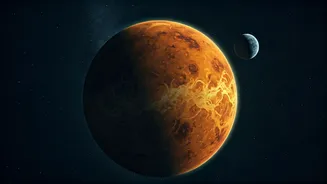
Venusian day—takes approximately 243 Earth days. Yes, you read that right. A day on Venus is about 18 Earth days longer than its year. Imagine celebrating your New Year's party and still having several weeks of daylight left from the *same day* you started on. This bizarre mismatch is the first clue that time on Venus operates by a completely different set of rules than what we are used to. It makes Venus the only planet in our solar system with a day longer than its year.
Spinning The Wrong Way
As if its lethargic spin wasn’t strange enough, Venus also rotates backwards. With the exception of Uranus, which is tilted on its side, every other planet in the solar system spins in the same direction it orbits the Sun, a motion called prograde rotation. This is why on Earth, the Sun rises in the east and sets in the west. On Venus, it’s the opposite. If you could stand on its surface, you would see the Sun rise very, very slowly in the west and crawl across the sky before setting in the east. This backward movement is known as retrograde rotation. Scientists believe this could be the result of a colossal impact with a planet-sized object billions of years ago, which essentially knocked Venus upside down and sent it spinning in the opposite direction. Another theory suggests that the gravitational pull of the Sun on Venus's thick atmosphere, combined with tidal forces, could have gradually braked its original spin and then reversed it.
The Heavy Atmosphere's Grip
The key to Venus’s weird timing isn't just in its past, but in its present atmosphere. Venus is shrouded in a crushingly dense blanket of carbon dioxide, with a surface pressure over 90 times that of Earth. This atmosphere is not static; it whips around the planet in a 'super-rotation' at speeds reaching 360 kilometres per hour, circling the entire globe in just four Earth days. Recent studies have shown that this thick, fast-moving atmosphere acts like a powerful brake, creating immense friction as it drags against the planet's surface. This atmospheric drag is so significant that it actually exchanges momentum with the solid planet, subtly altering the length of its day. The pull of the Sun also creates atmospheric 'tides' that tug on the planet, further influencing its rotation. It’s a dynamic, planetary-scale tug-of-war between the solid globe and its own atmosphere.
Living on Venusian Time
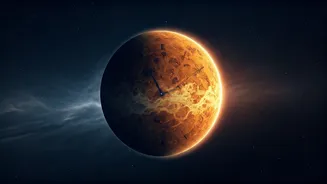
What would it be like to experience this? A single period of daylight on Venus lasts for about 117 Earth days, followed by an equally long night. This long, drawn-out solar cycle has catastrophic consequences for its surface temperature. The side facing the Sun bakes for months on end, contributing to the planet's average surface temperature of 465°C—hot enough to melt lead. The extreme slowness of the day means there's no rapid day-night cooling cycle like we have on Earth. Instead, the thick atmosphere traps heat, creating a runaway greenhouse effect that makes the entire planet an inhospitable furnace, day and night. For any robotic lander, this means surviving not just extreme heat and pressure, but also a day-night cycle that stretches for months.