




A Day Longer Than a Year
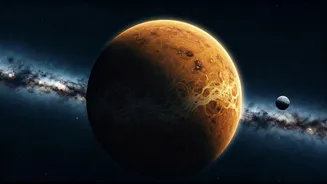
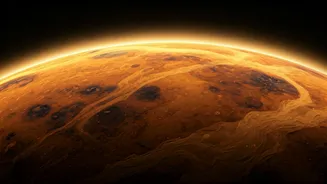
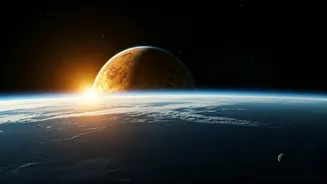
Let’s get the most brain-breaking fact out of the way first. A single day on Venus—the time it takes for the planet to complete one rotation on its axis—is approximately 243 Earth days. However, it only takes Venus about 225 Earth days to complete one full
orbit around the Sun. Yes, you read that right: a day on Venus is longer than its year. Imagine celebrating your first birthday before you’ve even lived through a single sunrise and sunset. This single, counter-intuitive piece of information is the foundation of Venus’s cosmic weirdness. It completely defies the rhythm of life we take for granted here on Earth, where our days are neat, tiny fractions of our year.
It Spins the Wrong Way
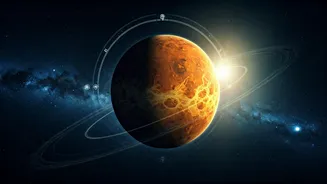
As if that weren’t strange enough, Venus also spins backwards. Nearly every other planet in our solar system, including Earth, rotates on its axis in a counter-clockwise direction (prograde motion). Venus, however, spins clockwise in what is known as retrograde rotation. The only other major planet that does this is Uranus, which is tilted so far on its side it’s practically rolling. Why does Venus spin this way? Scientists have a few theories, ranging from a colossal ancient impact that flipped its orientation to the Sun’s heavy gravity creating strong atmospheric tides that slowly reversed its spin over billions of years. Whatever the cause, it adds another layer to Venus’s reputation as the solar system’s resident oddball.
Why All the Buzz Now?
These facts aren't entirely new, but the conversation has reignited thanks to incredibly precise new data. A multi-year study using radar to bounce signals off Venus from Earth has nailed down its vital statistics with unprecedented accuracy. Researchers were able to determine the exact length of a Venusian day down to the minute, measure the precise tilt of its axis, and even get clues about the size of its core. The findings, published by a UCLA-led team, confirmed that the planet’s spin rate seems to vary slightly, possibly due to its thick, heavy atmosphere pushing on the surface. This isn’t just old news; it’s a fresh, high-definition look at our planetary neighbour, and the details are captivating science lovers and stargazers alike.
From Lab Data to Livestreams
The headline's mention of “exploding streams” captures the spirit of this renewed fascination. While amateur astrophotographers can’t visually *see* the planet's slow spin, the topic has become a source of profound awe and discussion within the community. For them, Venus often appears as a brilliantly bright, almost featureless dot or crescent. It’s beautiful but can lack the visual drama of Jupiter’s bands or Saturn’s rings. These bizarre rotational facts give Venus a personality. It’s no longer just a bright object; it's a cosmic mystery with a story. Online forums, Discord servers, and social media threads dedicated to astronomy are buzzing with discussions about the implications, turning a set of scientific data points into a shared moment of cosmic wonder.