



A Portrait of Galactic Chaos
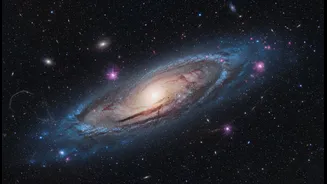
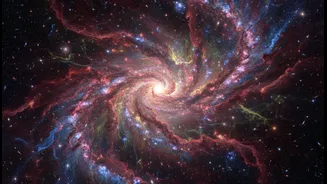
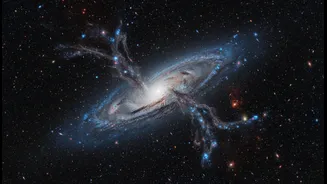
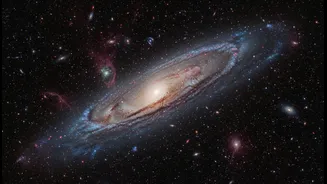
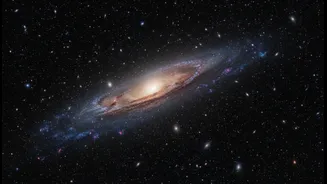
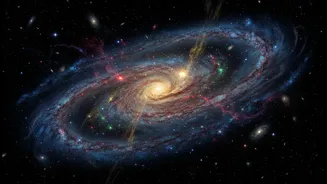
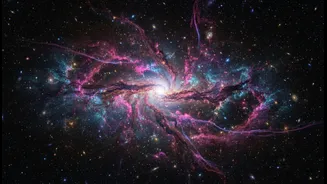
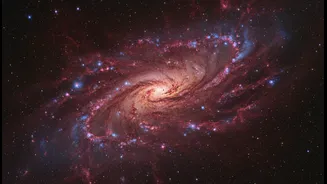
To the naked eye, Centaurus A is a faint smudge in the southern sky, but telescopes reveal a stunning and strange sight. It looks like a giant, glowing elliptical galaxy that has been torn apart and crudely stitched back together with a thick, dark belt
of dust. This peculiar feature was first noted in 1847 and is the most obvious clue that Centaurus A is not a simple, quiet galaxy but the site of a cataclysmic event. This chaotic appearance is why astronomers see it as a perfect natural laboratory for understanding how galaxies evolve, especially through violent mergers. It’s close enough to study in detail, yet active enough to showcase some of the universe's most powerful processes.
The Story of a Collision
The leading theory for Centaurus A's strange shape is that it's the product of a massive cosmic collision. Roughly two billion years ago, a large elliptical galaxy devoured a smaller, gas-rich spiral galaxy. The dark, dusty lane that defines its appearance is the mangled remnant of the smaller galaxy, its spiral arms and structure warped and absorbed. This merger event threw the entire system into disarray, providing a massive influx of fresh gas and dust that would become the fuel for the galaxy's future. The scars of this ancient battle are still visible today, not just in the dust lane but in the complex motions of its stars and gas.
The Monster in the Middle
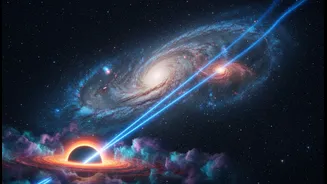
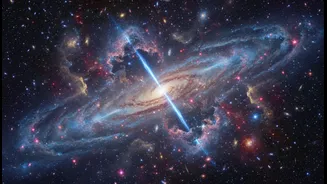
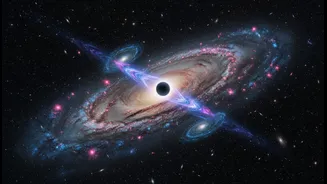
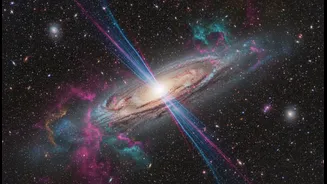
At the heart of Centaurus A lies a supermassive black hole, estimated to be around 55 million times the mass of our Sun. This isn't a dormant giant; it is an 'active galactic nucleus' (AGN), meaning it is actively feeding on the surrounding gas and dust supplied by the long-ago merger. As material spirals into the black hole, it releases tremendous amounts of energy, launching powerful jets of particles that travel at nearly half the speed of light. These jets are colossal, stretching over a million light-years from end to end, far beyond the visible galaxy itself. This activity has a profound effect, compressing some gas clouds to trigger star formation while blasting others away.
From Dust to New Life
Where there is cosmic dust, there is the potential for new stars. The vast quantities of dust and gas left over from the galactic collision are the raw materials for intense and ongoing star birth. Within the dark, turbulent dust lanes, astronomers have identified numerous bright red clouds of hydrogen and clusters of brilliant young blue stars. These stellar nurseries are a direct consequence of the merger, as the shockwaves from the collision compressed interstellar gas and kickstarted a flurry of star formation. In essence, the death of one galaxy has provided the ingredients for the birth of a new generation of stars within another.
A Modern Cosmic Laboratory
Centaurus A's relevance has grown immensely with the advent of powerful new observatories, most notably the James Webb Space Telescope (JWST). While the Hubble telescope struggled to see past the galaxy's thick dust in visible light, JWST's infrared vision can pierce through it, revealing the galaxy's core in unprecedented detail. For the first time, scientists can distinguish millions of individual stars within the central region, allowing them to perform a kind of 'galactic archaeology'. By studying different populations of stars, they can reconstruct a timeline of events: when the original stars formed, when the collision happened, and how star formation has ebbed and flowed since. This makes Centaurus A a crucial tool for testing theories about how all galaxies, including our own Milky Way, grow and change over billions of years.