

A New Window on the Universe
The latest marvel in astronomical engineering, NASA's James Webb Space Telescope (JWST), is living up to its promise of revolutionizing our understanding of the universe. In a recent release of images, astronomers unveiled breathtaking new views of 19
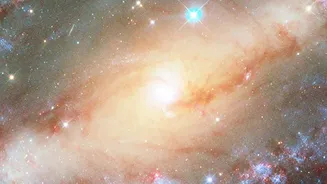
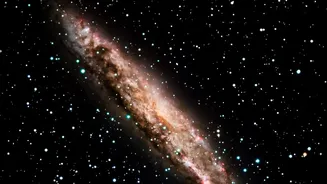
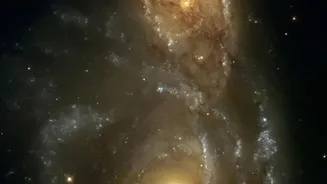
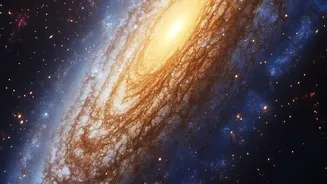
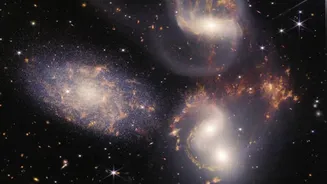
nearby spiral galaxies. While these galaxies have been studied for decades, JWST's powerful infrared capabilities provide an unprecedented look inside, cutting through the dense clouds of dust that have long obscured our view. The result is a collection of images that showcases these galactic marvels in unparalleled detail, making structures that were once faint smudges or entirely invisible spring to life. This isn't just about pretty pictures; it's a fundamental leap in our ability to see and study how galaxies work.
Seeing the Invisible
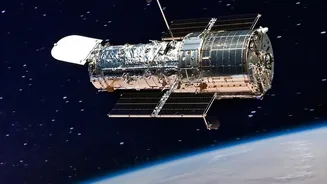
How does the JWST achieve this feat? The secret lies in its ability to detect infrared light. Much of what makes up a galaxy, including nascent stars and the building blocks of planets, is shrouded in vast quantities of cosmic dust. This dust acts like a celestial fog, blocking the visible light that telescopes like the Hubble Space Telescope primarily detect. However, the heat from stars warms this dust, causing it to glow brightly in infrared wavelengths. The JWST's instruments are specifically designed to capture this infrared glow, effectively making the dust transparent. This allows scientists to peer into the very heart of stellar nurseries and see the intricate 'skeletons' of galaxies—the fine, filamentary structures of gas and dust that trace the paths of star formation.
Galactic Structures in Sharp Focus
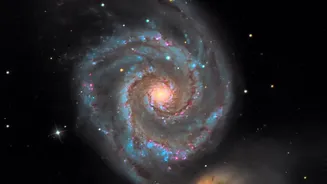
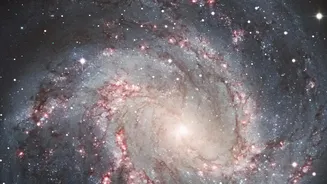
The new images have revealed a trove of previously hidden features. In galaxies like NGC 628, also known as the Phantom Galaxy, what appeared as dark, empty dust lanes to Hubble are now shown by JWST to be glowing, intricate networks where stars are being born. The images highlight the complex interplay between stars, gas, and dust on a remarkably small scale. Astronomers can now distinguish individual stars even in galaxies millions of light-years away, mapping out the distribution of stellar populations with incredible precision. In another galaxy, Centaurus A, JWST's mid-infrared vision has exposed a warped, parallelogram-shaped band of dust and a strange 'S' shaped feature at its core, raising new questions about the influence of its central supermassive black hole.
Rewriting the Story of Cosmic Evolution
These detailed observations are more than just a visual feast; they are crucial data points that will reshape our theories of galaxy evolution. For years, our understanding was biased because we couldn't see into the dustiest, most active regions of space. Now, by revealing these hidden components, JWST is helping astronomers build a more complete picture of how stars form and how galaxies grow. The data allows scientists to test and refine their computer simulations, leading to more accurate models of cosmic evolution. Furthermore, by studying galaxies at various distances and ages, from nearby spirals to mysterious 'Little Red Dots' in the early universe, JWST is piecing together the timeline of the cosmos, from the chaotic dawn of galaxy formation to the grand structures we see today.