
Finding a Needle in a Cosmic Haystack
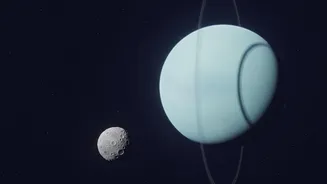
In late 2023, astronomer Scott Sheppard of the Carnegie Institution for Science spotted an incredibly faint object near Uranus using the powerful Magellan telescopes in Chile. At only about 8 kilometres across, the moon, provisionally named S/2023 U1,
is likely the smallest of Uranus's 28 known satellites. Finding it was a monumental task, requiring a special image-processing technique where long-exposure images were layered to reveal faint objects moving with the planet against a background of streaking stars. After the initial sighting, Sheppard and his colleagues had to confirm its orbit by finding the object in older images from 2021, proving it was a true satellite and not a passing asteroid.
An Oddball Planet with a Chaotic Past
To understand why this tiny moon matters, you first need to appreciate how strange Uranus is. Unlike other planets that spin like tops, Uranus is tilted almost 98 degrees, essentially rolling on its side as it orbits the sun. The leading theory for this extreme tilt is a cataclysmic collision with an Earth-sized protoplanet billions of years ago. This giant impact would have created a massive debris disc around the planet. Scientists believe Uranus's inner moons and faint rings formed from this disc, but the details have remained murky. The entire system is a puzzle box that astronomers are eager to solve.
Completing the Family Portrait
Discovering S/2023 U1 is like finding a long-lost photograph for a family album. Its orbit is distant, eccentric, and inclined, suggesting it was captured by Uranus’s gravity rather than forming in place. More importantly, its orbit is similar to two other irregular moons, Caliban and Stephano. This suggests they are all part of a 'family' — fragments of a single, larger parent moon that was smashed apart by a collision with a comet or asteroid long ago. By finding and cataloging these small, outer moons, scientists can build a more complete census of the Uranian system. A full census is crucial for testing and refining models of how the satellite system formed and evolved after the planet's dramatic tilt.
Clues Written in Gravity's Dance
Every object in a planetary system pulls on every other object. The discovery of S/2023 U1 provides another gravitational player in the complex dance of Uranus's moons. By precisely tracking its path over many years, astronomers can refine their calculations of the masses and densities of its neighbors. This helps them understand the composition of the moons—how much is ice versus rock. Furthermore, these tiny outer moons act as probes. Their distant, loosely-bound orbits are sensitive to the gravitational history of the entire system. Their current positions hold clues about past events, including potential disruptions from other planets or the capture of large objects like Neptune’s moon Triton, which may have once had a similar system.