





The Tree’s Plumbing System
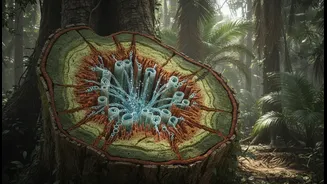
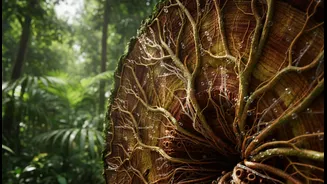
To understand why size matters, we first need to look at how a tree drinks. Every tree, from a tiny sapling to a towering giant, has an internal plumbing system called the xylem. Think of it as a massive bundle of microscopic straws running from the deepest
roots to the highest leaves. This system is responsible for pulling water and essential nutrients upward, a process powered by evaporation from the leaves, known as transpiration. The water column inside the xylem is held together by the strong cohesive forces between water molecules, allowing it to be pulled up under incredible tension, almost like a rope. This remarkable feat of natural engineering is what keeps a tree hydrated and alive.
What Are 'Hydraulic Traits'?
This is where the jargon comes in, but the concept is simple. 'Hydraulic traits' are the set of characteristics that define how well a tree's plumbing works. These traits determine how efficiently water can move and how safe the system is from failure, especially under stress. Key traits include the width of the xylem vessels (the 'straws'), the structure of the pits that connect them, and the overall resistance of the system. There's often a trade-off: wider vessels are more efficient, allowing for faster growth in good times, but narrower vessels are generally safer and more resistant to failure during a drought. A tree's specific set of hydraulic traits is its strategy for managing water.
The Trouble with Being Tall
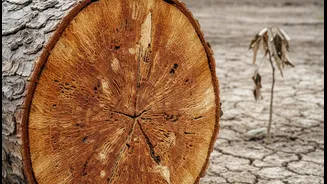
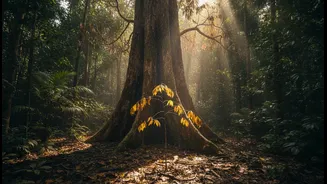
For a long time, scientists believed that tall trees were inherently more vulnerable to drought, and for a good reason: physics. A taller tree has to pull water much higher against gravity. This creates immense tension within the xylem. During a drought, when water is scarce, this tension becomes extreme. The system is pushed to its limits, increasing the risk of a catastrophic failure called 'cavitation'. This is when a tiny air bubble gets pulled into a xylem vessel, instantly expanding and creating a blockage, or 'embolism'. It's like a vapour lock in a fuel line, rendering that part of the plumbing useless. The taller the tree, the greater the tension, and the higher the risk of these blockages, which can lead to branch dieback and even tree death.
Small Trees and Different Strategies
Smaller trees don't have to fight gravity as hard. The shorter distance from root to leaf means their hydraulic system operates under less tension, making them less prone to cavitation just from height alone. However, they face their own challenges. With shallower root systems, small trees can be more vulnerable to short, intense droughts as the topsoil dries out quickly. Their strategy might involve being more conservative with water, closing their leaf pores (stomata) earlier to reduce water loss. Studies have shown that in some droughts, the smallest trees can experience high mortality early on, while in prolonged droughts, the taller trees eventually suffer more. Essentially, different sizes are vulnerable to different aspects of drought.
What Recent Experiments Reveal
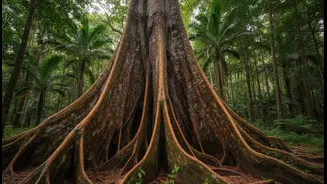
Scientific understanding is always evolving. While the 'tall trees are more vulnerable' theory is a strong general rule, recent experiments add nuance. A 2024 study on giant dipterocarp trees in Southeast Asia found they have developed remarkable adaptations. Their xylem vessels are wider at the base to reduce resistance, and their leaves can withstand drier conditions. These giants essentially rebuild their plumbing as they grow, meaning their height did not make them suffer more during a recent major drought. This doesn't disprove the general risk for tall trees, but it shows that some species have found clever ways to cheat physics. It highlights that the relationship also varies by species and the specific environment.
Why This Matters for India's Forests
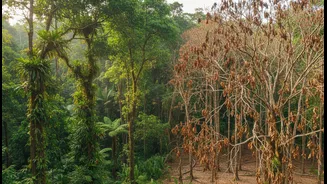
This research is crucial for understanding the future of tropical forests, including those in the Western Ghats, the Himalayas, and Northeast India. As climate change leads to more frequent and intense droughts, the composition of our forests could change dramatically. If tall trees are broadly more at risk, we could see a shift towards shorter, shrubbier forests. Such a change would have cascading effects, reducing the forest's ability to store carbon, altering local weather patterns that depend on transpiration, and threatening the biodiversity that relies on the complex canopy structure of tall, mature trees. Understanding which trees are most at risk allows for better conservation strategies and more accurate predictions about the future of these vital ecosystems.