
From Sunshine to Solar Winds
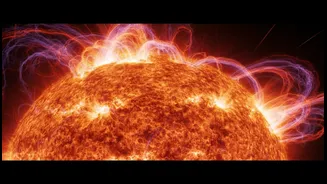
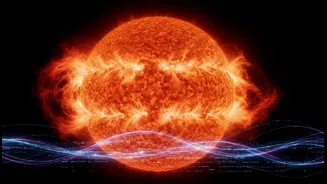
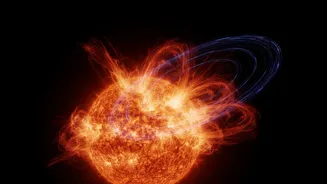
Space weather refers to the changing conditions in space, driven almost entirely by the Sun. Unlike terrestrial weather, it doesn't involve clouds or rain. Instead, it's about a constant stream of charged particles, known as the solar wind, flowing from
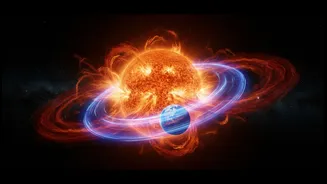
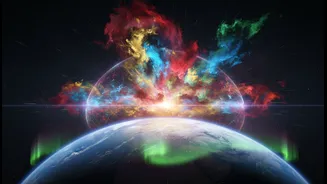
the Sun. This wind also carries the Sun's magnetic field with it. Earth is largely protected by its own magnetic field, the magnetosphere, which deflects most of this solar onslaught. However, the Sun is not always calm. It goes through periods of intense activity, creating storms in space that can overwhelm our planet's natural defences.
The Sun’s Explosive Outbursts
The main drivers of severe space weather are two types of solar explosions: solar flares and coronal mass ejections (CMEs). A solar flare is an intense burst of radiation that can reach Earth in just eight minutes, causing radio blackouts by disrupting the upper atmosphere. CMEs are even more significant. These are massive eruptions of magnetised plasma—a cloud of protons and electrons—that are hurled into space. If a CME is aimed at Earth, this billion-tonne cloud of solar material travels for one to three days before slamming into our magnetosphere, triggering what is known as a geomagnetic storm.
The Threat to Our Wired World
While a geomagnetic storm poses no direct danger to humans on the ground, it is a major threat to the technological infrastructure that underpins modern society. Strong storms can induce powerful electrical currents in long conductors on the ground. This was famously demonstrated in 1989 when a solar storm induced currents that collapsed the power grid in Quebec, Canada, leaving six million people in darkness. Beyond power grids, satellites are extremely vulnerable. The increased radiation can damage their electronics and solar panels, while atmospheric drag during a storm can cause them to fall out of orbit, as happened to 38 SpaceX satellites in 2022. This threatens everything from GPS navigation and financial transactions to television broadcasts and weather forecasting.
A New Era of Vulnerability
The need for accurate space weather predictions has become more urgent for two key reasons. First, our dependence on vulnerable technology is deeper than ever. From global supply chains and precision agriculture reliant on GPS to the ever-growing number of satellites for internet and communication, our modern way of life is precariously linked to space. Second, the Sun has become more active. We are currently in Solar Cycle 25, which began in 2019. This cycle has been significantly more active than scientists initially predicted, producing more sunspots and powerful eruptions, with its peak activity occurring around late 2024. The increased solar activity raises the probability of a major, Earth-directed storm.
The Global Race to Predict
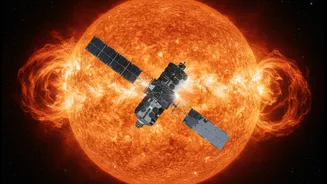
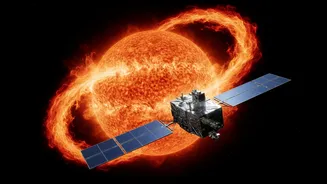
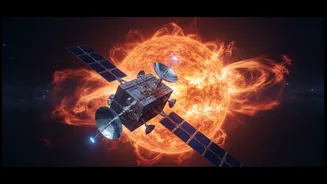
Forecasting space weather is a global effort. Scientists use a network of ground-based and space-based observatories to monitor the Sun for signs of an eruption. By watching for the formation of complex sunspot regions, they can issue warnings about the probability of a solar flare. Predicting the path and impact of a CME is more challenging. Spacecraft positioned between the Sun and Earth, like the NASA/ESA SOHO satellite, provide crucial data. For India, the Aditya-L1 mission, launched by ISRO, is a significant step forward. Positioned at Lagrange Point 1 (L1), about 1.5 million kilometres from Earth, it has an uninterrupted view of the Sun. Its instruments are designed to study the causes of solar storms and monitor them as they leave the Sun, providing critical data to help improve predictions and give advance warning—from hours to days—before a storm hits Earth.