


The Old Hunt for Watery Worlds
For decades, finding water on an exoplanet—a planet outside our solar system—has been a top priority for astronomers. The presence of water is considered a key ingredient for a planet to be potentially habitable. Scientists have traditionally used telescopes
like the Hubble Space Telescope to look for it. They use a technique called transit spectroscopy: when a planet passes in front of its star, a tiny fraction of starlight filters through its atmosphere. By analysing the spectrum of this light, scientists can identify the chemical fingerprints of molecules like water vapour. Several previous detections have sparked excitement, such as early observations of the super-Earth K2-18 b, which suggested a water-rich atmosphere. These findings, while groundbreaking, were based on limited data and left many questions unanswered.
A New Pair of Infrared Eyes
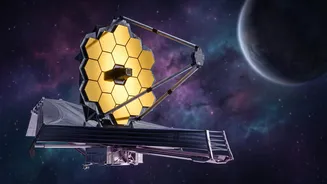
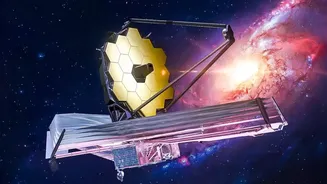
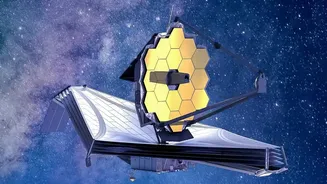
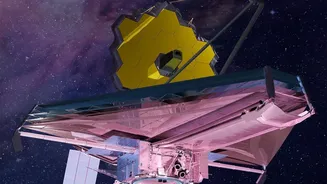
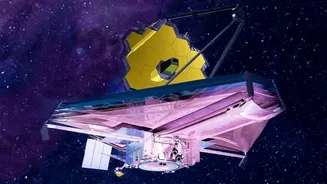
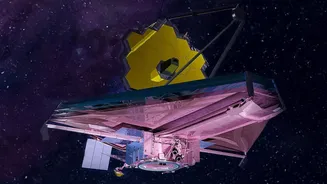
Enter the James Webb Space Telescope. Unlike its predecessors, JWST is designed to see the universe in infrared light with unprecedented clarity and resolution. This is a game-changer for studying exoplanet atmospheres. Many important molecules, including water, methane, and carbon dioxide, have strong absorption features in the infrared part of the spectrum. JWST’s powerful instruments, like its Near-Infrared Spectrograph (NIRSpec) and Mid-Infrared Instrument (MIRI), can capture these signals with stunning detail, allowing for a much more comprehensive inventory of an exoplanet's air. This new capability is providing a far more nuanced view, forcing scientists to revisit old assumptions.
When Data Complicates the Picture
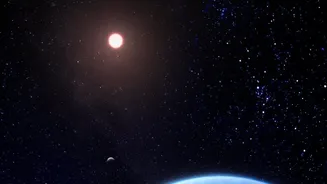
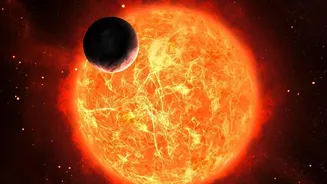
JWST’s data isn't just confirming old theories; it's actively challenging them. A major new insight is that what might look like a water signal could be something else entirely, or at least be complicated by other factors. One surprising discovery is the role of the host star itself. Astronomers studying the rocky exoplanet GJ 486 b found a signal that looked like water vapour. However, they could not confirm if the water was in the planet's atmosphere or coming from cool starspots—dark, cooler patches on the star's surface—which can also contain water vapour and mimic a planetary signal. This means that simply detecting water in a planet's transit isn't enough; scientists now must carefully disentangle the planet's signal from its star's.
Rethinking Atmospheric Models
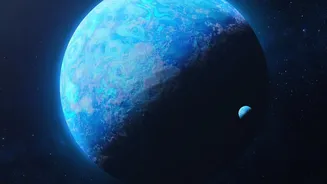
The new data is also showing that exoplanet atmospheres are more chemically diverse and complex than previously thought. On the exoplanet WASP-107b, JWST found water vapour, but also sulfur dioxide and clouds of silicate sand. The unexpected absence of methane on this 'fluffy' planet suggests its interior is much hotter than models predicted, challenging ideas about how such planets form and evolve. Similarly, observations of K2-18 b have become more complicated. While methane and carbon dioxide have been clearly detected, the initial strong signal for water vapour has been harder to pin down with JWST, with some analyses suggesting the planet may have a large ocean beneath its hydrogen-rich atmosphere rather than abundant vapour high up. These findings don't mean water isn't there, but that its form and our ability to detect it are subject to a host of other atmospheric conditions, like photochemistry and cloud composition, that earlier models didn't fully account for.
A More Refined Search for Life
This shift in understanding might seem like a setback, but it's actually a crucial step forward in science. The James Webb Space Telescope is replacing simple pictures with high-definition, complex portraits of alien worlds. Instead of just asking, "Is there water?", scientists can now ask more detailed questions: "In what form is the water?", "What other chemicals are present?" and "How does the atmosphere interact with its star?" For example, the detection of both methane and carbon dioxide on K2-18 b, alongside a potential biosignature like dimethyl sulfide (DMS), makes it a compelling target for understanding habitability, even if the water question is complex. This new era of precision is making the hunt for habitable worlds more challenging, but also much more rigorous and ultimately more rewarding.