




A Journey to Earth's 'Evil Twin'
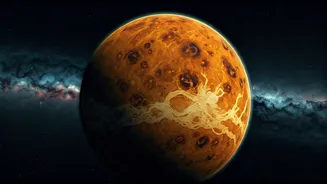
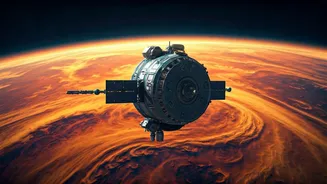
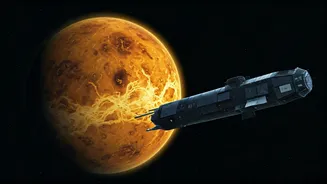
The Indian Space Research Organisation (ISRO) is setting its sights on our nearest planetary neighbour with its Venus Orbiter Mission, Shukrayaan-1. Tentatively scheduled for launch in 2028, this ambitious project will be India's first journey to the
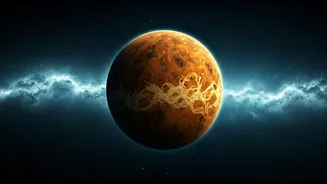
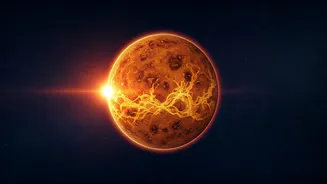
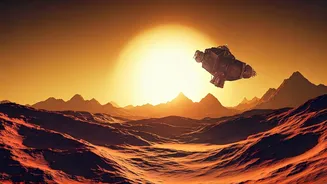
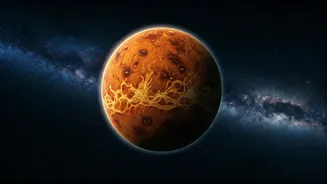
second planet from the sun. Venus is often called Earth's 'sister planet' or 'evil twin' because it is similar in size, mass, and density. But that's where the family resemblance ends. Venus is a toxic, hostile world, shrouded in thick clouds of sulphuric acid and boasting a scorching surface temperature of over 460°C. Its atmosphere is over 96% carbon dioxide, creating a surface pressure 90 times greater than Earth's. The mission aims to send an orbiter with a suite of scientific instruments to study the Venusian surface and its dense, mysterious atmosphere.
A Cautionary Tale Written in the Clouds
For climate scientists in India and across the globe, Venus serves as a giant, natural laboratory for studying the most extreme case of the greenhouse effect. Scientists believe Venus may have once been a temperate world with liquid water oceans, much like Earth. However, less than a billion years ago, a runaway greenhouse effect is thought to have transformed it. As the planet trapped more and more heat, its oceans boiled away, leaving the parched, infernal landscape we see today. By studying this catastrophic climate shift, scientists hope to better understand the tipping points and feedback loops that can dramatically alter a planet's environment. This provides a powerful, if terrifying, cautionary tale about how drastically a planet's climate can change.
The Scientific Toolkit for a Hostile World
Shukrayaan-1 will carry around 100 kg of scientific payloads designed to peer through the planet's opaque atmosphere and unlock its secrets. A key instrument is a high-resolution Synthetic Aperture Radar (SAR), which can map the surface geology and look for signs of volcanic activity, regardless of the cloud cover. Other instruments will analyze the composition and dynamics of the atmosphere, studying its chemistry and super-rotating winds. International collaborations, including payloads from Russia, France, Sweden, and Germany, will enhance the mission's capabilities, studying everything from the solar wind's interaction with the upper atmosphere to the composition of gases. One of the most anticipated payloads is a ground-penetrating radar, which would be a world-first for Venus, aiming to study the planet's subsurface stratigraphy.
Refining Climate Models Back on Earth
The ultimate value of this mission for Indian climate scientists is the data it will provide to improve our own climate models. The computer models used to predict climate change on Earth are incredibly complex, but they are only as good as the data and physical laws they are built upon. By testing these models against the extreme conditions found on Venus, scientists can identify weaknesses and refine their accuracy. Understanding the physics of a runaway greenhouse effect on Venus provides critical data points that make Earth-based predictions more robust. For a country like India, which is particularly vulnerable to the impacts of climate change, from extreme weather to shifting monsoon patterns, more accurate climate models are not just an academic exercise—they are essential tools for future planning, adaptation, and mitigation.