



A Cosmic Sorting Hat
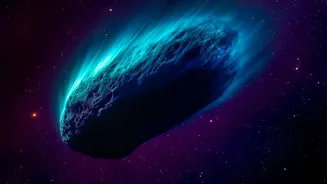
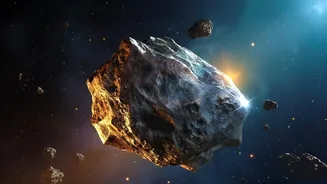
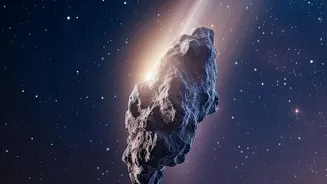
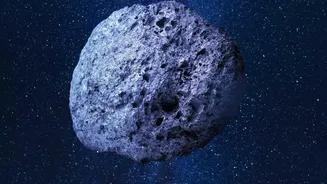
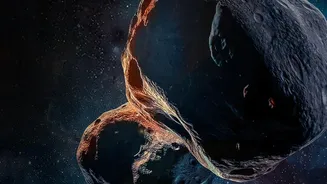
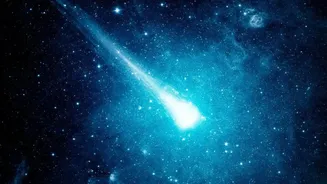
Before we can understand their paths, it helps to know what we’re looking for. The main characters in this cosmic drama are asteroids, comets, and meteoroids. Asteroids are generally rocky or metallic bodies orbiting the Sun, mostly found in the vast
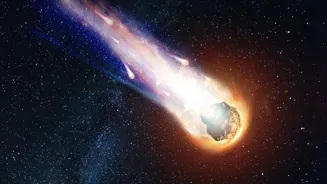
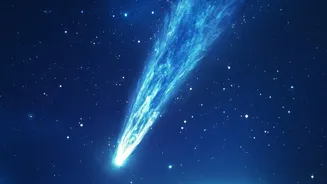
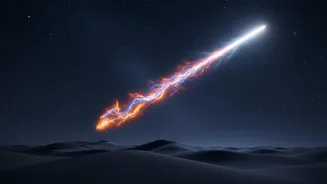
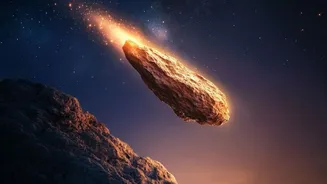
asteroid belt between Mars and Jupiter. Comets, often called "dirty snowballs," are made of ice, dust, and rock. They typically come from the frigid outer reaches of the solar system, like the Kuiper Belt or the even more distant Oort Cloud. Meteoroids are smaller pieces, often fragments of asteroids or comets. If they enter Earth’s atmosphere, they become meteors (or shooting stars), and if a piece survives to hit the ground, it’s a meteorite. Distinguishing between these objects is the first step in understanding their nature and potential risk.
The Story Told by a Path
A trajectory is simply the path an object follows through space, governed by its initial speed, direction, and the gravitational forces of larger bodies like the Sun and planets. By taking multiple pictures of the sky minutes apart, astronomers can spot moving objects against the fixed background of stars. These observations allow them to calculate the object's orbit. It’s this orbital path, or trajectory, that provides a wealth of information. Is the orbit a relatively stable, near-circular path, like those of asteroids in the main belt? Or is it a long, highly elliptical loop that swings in close to the Sun before heading back into deep space? This is the signature of a comet. The shape of the path is a fundamental clue to the object's identity and origin.
Tracing Back to the Source
One of the most powerful insights from trajectory analysis is determining an object's origin. An object with a path that originates in the asteroid belt is very likely a rocky asteroid. In contrast, an object with a long, looping orbit that traces back to the Oort Cloud is almost certainly an icy comet. Trajectory can even identify interstellar visitors. While objects within our solar system follow closed elliptical orbits, an object entering from another star system will have such a high velocity that the Sun's gravity can't capture it. Its path will be an open-ended hyperbola, a clear sign that it’s just passing through. Knowing where a space rock came from helps scientists infer its composition—rock and metal versus ice and dust—which is crucial for both scientific study and planetary defense.
A Matter of Planetary Defense
Ultimately, the most critical reason for tracking trajectories is planetary defense. Organizations like NASA's Planetary Defense Coordination Office (PDCO) are tasked with finding and tracking near-Earth objects (NEOs) that could pose an impact hazard. An NEO is any asteroid or comet whose orbit brings it within 1.3 astronomical units (about 195 million kilometers) of the Sun. By precisely calculating an object’s trajectory, scientists can predict its future path for decades or even a century. This allows them to determine if it will cross Earth's orbit and, if so, calculate the probability of an impact. The more observations they collect over time, the more refined their orbital predictions become, reducing uncertainty. This early warning system is humanity's first line of defense against a preventable natural disaster.
More Than Just a Flight Plan
While trajectory is a primary tool, it works in concert with other methods. Once an object is flagged, astronomers use other techniques to learn more. Spectroscopy, which analyzes the light reflected off an object's surface, can reveal its chemical composition. Radar observations can provide detailed information about an object's size, shape, and rotation. By combining trajectory data with these physical characteristics, scientists can build a comprehensive profile of a space rock. This complete picture is vital for assessing the threat posed by a potentially hazardous object and, if necessary, planning a mission to deflect it.