







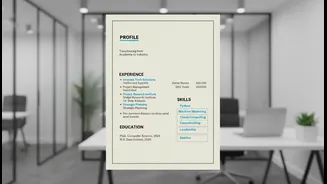


From Academic Record to Marketing Document
The fundamental tension lies in the purpose of the document. An academic Curriculum Vitae (CV) is a comprehensive, historical record of your intellectual life. Its goal is to demonstrate scholarly expertise through an exhaustive list of publications,
conferences, and teaching experiences. In academia, length can signify depth. In contrast, an industry resume is a forward-looking marketing tool. Its sole purpose is to convince a recruiter, in seconds, that you are the right fit for a specific job by highlighting relevant skills and potential business impact. While Indian recruiters may be open to a two-page resume for experienced professionals, clarity and conciseness are still paramount. The mindset must shift from documenting everything you've done to marketing what you can do for them.
Swap Your Objective for a Professional Summary
Many academic CVs either omit a summary or begin with a section on research interests. Industry resumes, however, benefit immensely from a powerful professional summary at the top. This is not a vague "objective" statement about wanting a challenging role. Instead, it's a 3-4 line pitch that summarises your expertise, key skills, and what you bring to the table. It should be tailored to each job, using keywords from the job description to get past Applicant Tracking Systems (ATS) and catch the recruiter's eye. Think of it as the trailer for your career: it needs to be compelling enough to make them want to watch the whole movie.
Focus on Accomplishments, Not Just Duties
Academic CVs often list responsibilities: "Conducted research on protein folding," or "Taught undergraduate courses." Industry recruiters want to see impact. The key is to translate your duties into quantifiable achievements. Instead of just listing responsibilities, use action verbs and numbers to showcase results. For example, "Conducted research" becomes "Managed a two-year research project with a ₹20 lakh budget, delivering findings that were published in a top-tier journal." "Taught courses" becomes "Instructed and mentored 50+ undergraduate students per semester, achieving a 95% positive feedback rating." This reframing demonstrates not just what you did, but how well you did it.
Curate Your Publications, Don't List Them All
For an academic, a long list of publications is a badge of honour. For an industry hiring manager, it's often irrelevant noise that clutters the document. They are not going to read your papers; they want to know if you can solve their problems. Instead of listing every single article, create a section titled "Selected Publications" and include only the two or three most relevant or prestigious ones. You can always provide a link to your full Google Scholar or ResearchGate profile for those who are interested. This shows you understand the audience and can distinguish between what is important in an academic context versus a business one.
Highlight Transferable and Technical Skills
Your deep knowledge of 18th-century poetry might not be directly applicable to a project management role, but the skills you used to gain that knowledge are. Academics excel at project management, data analysis, critical thinking, grant writing (which is like business development), and communication. These are the transferable skills that industry employers value. Create a dedicated "Skills" section and divide it into categories. In the Indian context, there is a strong emphasis on hard, technical skills, so be specific. List programming languages (Python, R), software (Tableau, MATLAB), lab techniques, and data analysis methods you've mastered. This makes it easy for recruiters to see you have the practical abilities they need.
Keep It Concise and Jargon-Free
An academic CV can run for many pages, but an industry resume should ideally be no more than two pages, especially in the competitive Indian job market. Brevity signals that you can prioritise and communicate effectively. Equally important is to strip out academic jargon. Words and acronyms that are common in your specific field may be meaningless to an outside recruiter. Have a friend outside of academia read your resume. If they have to ask, "What does that mean?" then you need to rephrase it. Using clear, accessible language ensures your message gets across without confusion, making the recruiter's job easier and increasing your chances of landing an interview.