




Monsanto: The Village Built Amongst Boulders
Often called 'the most Portuguese village in Portugal', Monsanto is a marvel of human ingenuity and respect for nature. Located near the Spanish border, this village is famous for its houses built around, under, and even on top of gigantic granite boulders.
Instead of removing the massive stones, the village's founders incorporated them directly into their architecture. You'll find homes where a single massive rock serves as the roof, known as Casa de Uma Só Telha ('House of One Tile'), and others where boulders form the walls and floors. Winding paths lead you through this living museum, up to the formidable 12th-century Templar castle that crowns the hill. The fortress, half-natural stone and half-man-made, offers breathtaking views over the plains, reinforcing its historical strategic importance.
Óbidos: The Queen's Romantic Walled Town
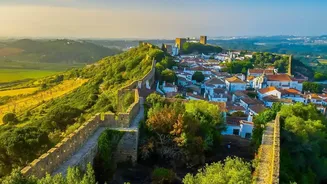
Step back in time in Óbidos, a perfectly preserved medieval town encircled by fortified walls. For centuries, it was the traditional wedding gift from Portuguese kings to their queens, earning it the nickname 'Vila das Rainhas' (Town of the Queens). You can enter the town through the southern gate, Porta da Vila, which is adorned with traditional blue and white tiles. Inside, a labyrinth of cobbled streets, whitewashed houses brightened with bougainvillea, and charming shops awaits. The main street, Rua Direita, leads you towards the impressive castle, which now houses a luxurious Pousada (historic hotel). Be sure to walk along the 1.5-kilometre perimeter of the walls for stunning views of the town and the surrounding countryside, and don't leave without trying Ginja de Óbidos, a local cherry liqueur often served in a chocolate cup.
Marvão: The Eagle's Nest on the Border
Perched dramatically atop a granite crag at 862 metres, Marvão is a formidable sight. This walled village in the Alentejo region, close to the Spanish border, has been a strategic stronghold since Roman times. Its elevation provides spectacular panoramic views across the Alentejo plains and into Spain. Inside the 13th and 17th-century walls, you'll find a tranquil village of narrow, winding streets and whitewashed houses with terracotta roofs. The entire village seems to lead upwards to the magnificent castle at its highest point. Exploring the castle's ramparts, you can appreciate why it was considered impregnable for centuries. The combination of its dramatic setting, historical significance, and serene atmosphere makes Marvão an unforgettable stop.
Sortelha: A Medieval Granite Stronghold
Sortelha is one of Portugal's best-preserved and oldest historical villages, with an urban layout that has remained virtually unchanged since the Renaissance. Situated at an altitude of 760 metres, the village is enclosed by a ring of walls overlooked by a 13th-century castle. The granite houses and cobbled streets evoke a powerful medieval atmosphere. The village's name is said to derive from the ring-like shape of the rocky terrain ('sortija' in Castilian). Entering through the Gothic gateway, you can explore the network of alleys, see the 16th-century pillory, and discover the main church with its Hispano-Arabic influences. The entire village is a testament to its past as a key defensive point on the border.
Piódão: The Hidden Schist Village
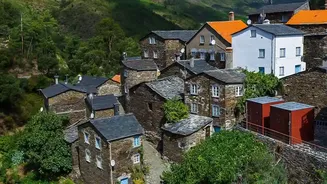
Tucked away in a remote valley of the Serra do Açor mountains, Piódão is often called the 'nativity scene village' for the way its houses cascade down the hillside in an amphitheatre shape. What makes Piódão unique is its architecture; the homes and streets are built almost entirely from schist, a dark, slate-like stone abundant in the region. This gives the village a harmonious, earthy feel, punctuated by the vibrant blue painted on doors and windows. For centuries, Piódão was almost completely isolated, accessible only on foot or horseback until the 1970s, which helped preserve its unique character. The bright white parish church, Igreja de Nossa Senhora da Conceição, stands in stark contrast to the dark stone of the surrounding buildings, creating a striking focal point.