
Cosmic Forensics and Origin Stories
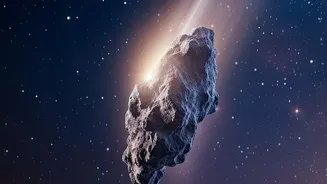
Think of a meteorite as a clue from a cosmic crime scene. A rock that lands on Earth is scientifically valuable, but without knowing its trajectory through space, it's a clue without context. Scientists can analyze a meteorite's composition to understand
what it's made of. But by calculating its original orbit, they can trace it back to its source. Was it a fragment from the asteroid belt between Mars and Jupiter, a piece of Mars itself knocked off by an ancient impact, or even a remnant of a passing comet? Each origin tells a different story. The path is the crucial link that connects the rock in their lab to a specific region of our solar system, turning a simple stone into a messenger from billions of years ago.
Reading the Solar System's Blueprint
Most meteoroids are fragments left over from the formation of our solar system, roughly 4.6 billion years ago. They are pristine, time-capsule materials that were never incorporated into a planet. By studying them, we learn about the original ingredients that built worlds, including our own. Knowing a meteoroid's pre-entry orbit allows researchers to map where different types of materials existed in the early solar system. For example, linking specific types of meteorites to certain parts of the asteroid belt helps create a geological map of this vast, rocky region. This work helps answer fundamental questions: How were planets formed? How were water and organic molecules—the building blocks of life—delivered to the young Earth? The rock's path provides the address for its story.
A Planetary Early Warning System
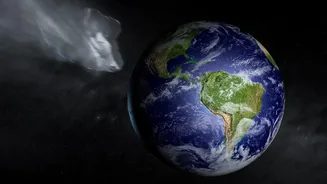
Beyond historical science, there is a much more immediate reason to track space rocks: planetary defense. While most meteoroids are small and burn up harmlessly in the atmosphere, larger asteroids pose a genuine threat. The 2013 Chelyabinsk event in Russia, caused by an approximately 18-meter object, created a shockwave that injured hundreds and caused widespread damage. That object went undetected before it entered the atmosphere. Planetary defense programs around the world, like those at NASA and ESA, are dedicated to finding and tracking near-Earth objects (NEOs) to assess any potential impact risk. The earlier a potentially hazardous asteroid is detected, the more time we have to react. Tracking its path precisely is the first and most critical step in preventing a catastrophe.
From Theory to Action
Studying an asteroid's trajectory isn't just a passive act of watching. It provides the necessary data for active defense strategies. If an asteroid is found to be on a collision course with Earth, knowing its exact orbit is essential for planning any deflection mission. NASA's recent DART (Double Asteroid Redirection Test) mission successfully demonstrated that crashing a spacecraft into an asteroid can alter its course. The success of such a mission depends entirely on precise calculations of the target's speed, direction, and position—all elements derived from tracking its path over time. Without that data, attempting to intercept a small, fast-moving object millions of kilometres away would be impossible. Each observation helps refine an object's predicted path, reducing uncertainty and allowing for a more effective response if one is ever needed.