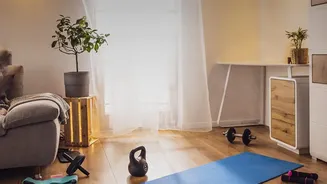






Forget expensive gym memberships and bulky equipment. The most effective fitness tool you own is your own body. Bodyweight training offers a powerful, convenient, and free way to build strength and improve your health right from your living room.
Why Your Body Is Enough
Bodyweight
training is a form of strength training that uses your own body to create resistance against gravity. This approach is not only convenient and cost-effective, but it's also highly effective for building a strong, functional foundation. Because these exercises often mimic everyday movements like pushing, pulling, and lifting, they improve your 'functional fitness', making daily tasks easier. They are also generally easy on the joints compared to heavy weightlifting. You can do them anywhere, anytime, making it easier to stay consistent with your fitness goals whether you have five minutes or thirty.
The Foundational Full-Body Movements
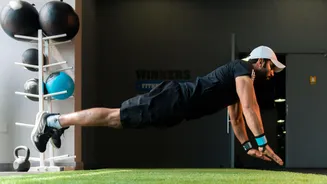
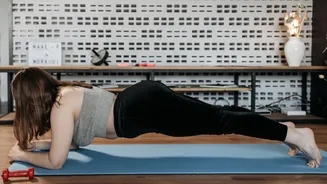
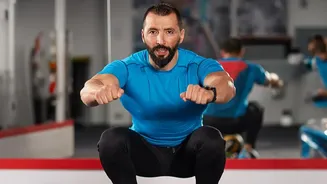
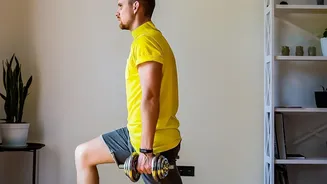
A balanced routine should work all major muscle groups. You can create a comprehensive full-body workout with just a few key exercises. Squats are a cornerstone for lower-body strength, targeting the quads, hamstrings, and glutes. Push-ups are one of the best moves for the upper body, engaging the chest, shoulders, and triceps. Lunges challenge your balance and work each leg individually, which is important for walking and running. For your core, the plank is a fantastic exercise for building stability and strength. Finally, glute bridges target your glutes and hamstrings, which are crucial for posture and lower back health.
Making Progress Without Adding Weight
The key to getting stronger is 'progressive overload'—gradually increasing the challenge on your muscles. With bodyweight training, you can't just add another plate to a barbell, but the principle is the same. There are many ways to make exercises harder. You can increase the number of repetitions or add another set to your workout. Another method is to slow down the movement, especially the lowering phase of an exercise, which increases time under tension. You can also progress to more challenging variations, such as elevating your feet for push-ups or trying single-leg versions of squats and glute bridges.
How to Structure Your Workout
For beginners, aiming for two to three full-body sessions per week is a great start, ensuring you have at least one rest day in between to allow your muscles to recover. A simple circuit format works well. Choose four to six exercises that cover the upper body, lower body, and core. Perform each exercise for a set number of reps (e.g., 10-15) or a set time (e.g., 30-45 seconds), moving from one to the next with minimal rest. After completing all the exercises, rest for 60-90 seconds, and then repeat the entire circuit for 2-3 rounds. Always start with a light warm-up of 5-10 minutes, like jogging in place or arm circles, and finish with some stretching to aid recovery.