




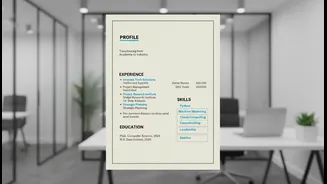




Mindset Shift: From CV to Résumé
The first step in transitioning from academia to industry is understanding that you are no longer creating a Curriculum Vitae, or "course of life." Your new goal is to write a résumé. An academic CV is a comprehensive record of your entire scholarly history,
often stretching across many pages. A résumé, by contrast, is a concise marketing document, typically one to two pages, designed to sell your skills for a specific role. Hiring managers spend mere seconds scanning each application. Your goal is no longer to list everything you have ever done, but to highlight only what is relevant to the job at hand, proving you can deliver value to the company.
Translate Your Achievements into Business Value
Industry recruiters are not looking for a list of duties; they are looking for impact. Your academic work is full of achievements, but you must translate them into the language of business. Instead of simply stating you "conducted research on topic X," reframe it with a focus on results. For example, that research likely involved managing a project, working with a budget, analyzing complex data, and presenting findings to stakeholders. These are all valuable business skills. Frame your grant writing experience not just as securing funds, but as persuasive communication and financial management. Position your teaching experience as leadership, public speaking, and effective communication.
Quantify Your Impact
Whenever possible, use numbers to demonstrate the scale and success of your work. Metrics provide tangible evidence of your ability to drive results. Instead of saying you mentored students, state that you "mentored 15 undergraduate students, leading to three co-authored publications." Rather than mentioning you managed a lab, specify that you "managed a lab budget of ₹5 lakh and supervised a team of four researchers." Quantifying your accomplishments helps a hiring manager, who may not understand the nuances of your research, grasp the concrete impact of your contributions.
The Academic Detox: What to Cut
A crucial part of this process is being ruthless about what you remove. Long lists of publications, conference presentations, and academic committee memberships are highly valued in academia but are often irrelevant noise to an industry recruiter. A simple line like, "5 first-author publications in peer-reviewed journals including Nature Communications" is more effective than listing every single one. Avoid academic jargon. Instead of describing the niche methodology of your research, explain the problem you solved and the outcome you achieved in plain language. Also, unless the job description specifically asks for them, remove references from your resume.
Structure for Scannability and Keywords
Corporate recruiters often use Applicant Tracking Systems (ATS) to filter candidates. These systems scan for keywords that match the job description. Your resume should be tailored for every application, incorporating specific terms from the job posting like "project management," "data analysis," or specific software proficiencies. Start with a strong professional summary—three to five sentences that pitch your top skills and career goals. Use clear headings like "Professional Experience," "Skills," and "Education." Employ bullet points with action verbs to describe your accomplishments, making the document easy to scan and digest.