








New Frontiers: Porpanaikottai and Vembakottai
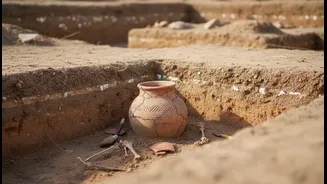
The focus has now expanded to several sites, with Porpanaikottai in Pudukkottai district and Vembakottai in Virudhunagar district revealing remarkable finds. At Porpanaikottai, where a Sangam-age fort is believed to have existed, excavations have unearthed
a unique circular brick structure, a brick water canal, and thousands of artefacts including gold pieces, carnelian beads, and bone weaving tools. These discoveries point to a sophisticated, wealthy settlement with advanced construction and craftsmanship. Meanwhile, excavations at Vembakottai, situated on the banks of the Vaippar river, have yielded over 7,800 artefacts across several phases, including gold ornaments, terracotta seals, and intriguing fragments of 'torpedo jars'. These jars are historically associated with Roman and West Asian trade, suggesting robust overseas connections.
The Keeladi Context
To understand the excitement, one must look back at Keeladi. Excavations there since 2015 provided stunning evidence of a secular, urban civilization on the banks of the Vaigai river dating back to at least the 6th century BCE. The discovery of well-planned brick structures, advanced drainage systems, industrial-scale craft production, and pottery with Tamil-Brahmi inscriptions pushed the timeline of the Sangam Age further into antiquity. It challenged long-held assumptions about Indian history and provided material proof for what had been largely known through Sangam literature. Keeladi established that a sophisticated, literate, and non-agrarian society thrived in southern India, seemingly independent of the Gangetic plain civilizations.
What New Questions Are Being Asked?
The latest discoveries are not just adding more sites to the map; they are raising crucial new questions. The primary question is one of connection. Were sites like Porpanaikottai, Vembakottai, and Keeladi part of an interconnected network of settlements? The discovery of torpedo jar fragments at Vembakottai, for instance, hints at extensive trade networks along the Vaippar river, potentially linking inland production centres to maritime routes. The structural findings at Porpanaikottai, such as a large fort and circular constructions, also bring up questions about the nature of these settlements. While Keeladi appears to be an industrial and trade hub, Porpanaikottai might have served a strategic or administrative purpose. This diversity suggests a complex societal structure across the region. Furthermore, the discovery of graffiti-marked pottery, considered a precursor to the Tamil-Brahmi script, continues to fuel the debate on the origins and timeline of writing in South India.
A Deeply Contested Past
The archaeological journey is not without its controversies. The dating and interpretation of Keeladi's findings have been subjects of intense debate between the state archaeological department and the Archaeological Survey of India (ASI). There have been allegations of delays in publishing reports and transfers of key archaeologists, turning the scientific pursuit into a politically charged issue about regional identity and national historical narratives. The ASI has requested revisions to initial reports, questioning the early dating proposed by the original excavators, while the Tamil Nadu government has moved forward, even establishing a site museum at Keeladi. This underlying tension means every new discovery at sites like Porpanaikottai and Vembakottai is scrutinized not just for its academic merit, but for its role in this larger cultural and political debate.