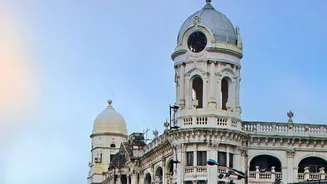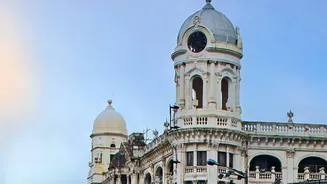





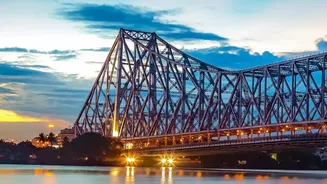

Walk through Kolkata, and you’ll hear whispers of its old title: 'The London of India'. This isn't just a nickname; it's a story etched in stone, visible in the grand, imposing buildings that line its historic streets.
The City of Palaces
For over a century, until 1911, Kolkata—then
Calcutta—was the capital of British India. This status made it the second most important city in the British Empire, after London itself. As the administrative and commercial epicentre, immense wealth and power flowed through its streets, financing the construction of magnificent structures designed to project imperial authority. Architects employed a range of European styles, from Neoclassical and Gothic Revival to Victorian, creating a cityscape so grand it was often called the 'City of Palaces'. This architectural boom, combined with its political importance and its location on the Hooghly River, much like London on the Thames, cemented its reputation as the 'London of India'.
An Architectural Tour of B.B.D. Bagh
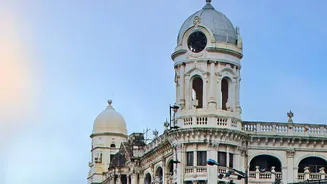
Nowhere is this legacy more concentrated than in the area formerly known as Dalhousie Square, now B.B.D. Bagh. This zone is a living museum of colonial architecture. Dominating the landscape is the Writers' Building, a massive red-brick structure that once served as the administrative headquarters for the East India Company. Nearby, the General Post Office (GPO) impresses with its high domed roof and towering Corinthian pillars. The square is also home to St. John's Church, modeled after St. Martin-in-the-Fields in London, and the historic Currency Building. This single area contains one of the densest collections of British colonial heritage monuments anywhere in the world.
Victoria Memorial: The Crown Jewel
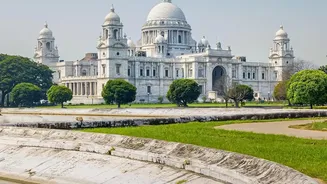
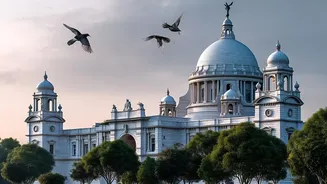
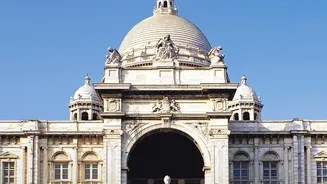
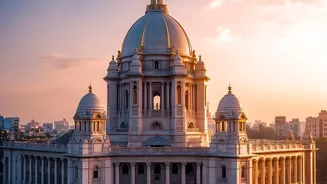
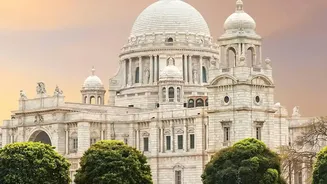
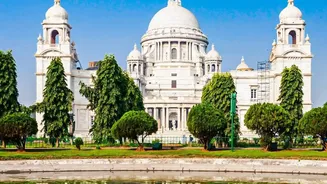
Perhaps the most iconic symbol of colonial Kolkata is the Victoria Memorial. Commissioned by Lord Curzon after Queen Victoria's death in 1901 and completed in 1921, this majestic monument is built from the same Makrana marble as the Taj Mahal. Its design is a prime example of the Indo-Saracenic style, which masterfully blends British architectural principles with Mughal, Venetian, and other influences. Crowned by a bronze Angel of Victory, the memorial was conceived not just as a tribute, but as a museum and a national gallery. Today, surrounded by 64 acres of gardens, it stands not just as a relic of the Raj, but as a vital public space and cultural hub for the citizens of modern Kolkata.
Beyond the Administrative Core
The colonial influence extends far beyond the city's administrative heart. St. Paul's Cathedral, consecrated in 1847, is a stunning example of Gothic Revival architecture and was the first episcopal church built in Asia. The Indian Museum, one of the oldest in the country, and the Calcutta High Court are other prime examples of the era's architectural ambitions. Even palatial private residences like the Marble Palace, built by a wealthy Bengali merchant, showcase a unique fusion of Neoclassical European styles with Indian and even Chinese elements, reflecting the cosmopolitan nature of the city during that period.
A Complicated but Cherished Heritage
For decades after independence, many of these colonial structures were viewed as uncomfortable reminders of British rule and were left to decay. However, attitudes have shifted significantly. There is a growing recognition that this architecture, while born from a period of colonial subjugation, is an inseparable part of Kolkata's unique identity and history. Preservation efforts, driven by both government and citizen groups, have ramped up to protect these buildings from demolition and neglect. The debate continues, but today, these architectural marvels are largely seen not as symbols of oppression, but as a shared heritage—a testament to the city’s complex, layered past and a major draw for tourism and cultural appreciation.