








Why It’s a Core Game-Changer
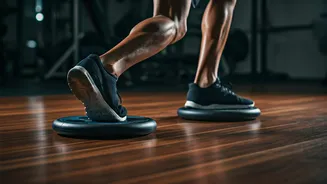
The reverse lunge is a fantastic exercise on its own, targeting your glutes and quads while improving balance. But when you add a sliding disc, the entire dynamic shifts. The unstable surface of the disc under your foot forces your body to fight for stability
with every repetition. Where does this stability come from? Your core. Your deep abdominal muscles, obliques, and lower back have to fire in unison to prevent you from wobbling or losing your posture. This isn't the kind of gentle engagement you get from a plank; it's an intense, constant activation that builds true functional strength. Every time you slide your leg back and pull it forward, you’re not just working your leg—you're performing a powerful, loaded core exercise that also enhances hip mobility and single-leg strength.
Your Step-by-Step Guide
To get the most out of this exercise, form is everything. Focus on control, not speed. If you don't have sliding discs, a small towel on a smooth floor (wood, tile) or a paper plate on a carpet works just as well. 1. Get into Position: Stand tall with your feet hip-width apart. Place the ball of one foot onto the center of the sliding disc. Keep your chest up and your core braced, as if you’re about to take a punch. 2. The Slide Back: Keeping your weight in the heel of your stationary (front) foot, slowly slide the disc straight back. As your leg extends, lower your hips until your front thigh is parallel to the floor and both knees are at roughly a 90-degree angle. Your back knee should hover just above the ground. 3. The Squeeze and Return: This is where the magic happens. Squeeze your glutes and abs, and use your front leg and core to powerfully pull the sliding disc back to the starting position. Avoid using momentum. The movement should be deliberate and controlled. Complete all reps on one side before switching to the other.
Avoid These Common Form Fails
A great exercise done incorrectly can lead to injury. Watch out for these mistakes to ensure you’re getting results safely. * Rounding Your Back: This is the most common error. It happens when your core isn't engaged, and it puts unnecessary stress on your lower back. Keep your chest lifted and your spine neutral throughout the movement. * Letting the Front Knee Cave In: Your stationary knee should track over your foot. If it collapses inward, you're putting your knee joint at risk. Focus on pushing the knee outward slightly to engage your glutes. * Going Too Fast: This is an exercise in control, not a race. Using momentum robs your muscles—especially your core—of the work. A slow, controlled slide back and a powerful, deliberate pull forward is far more effective. * Putting Weight on the Back Foot: Your front, stationary leg should be doing the majority of the work. The back leg on the disc is there for instability and movement, not for bearing weight.
How to Add It to Your Routine
Because this move is demanding, it’s best to incorporate it thoughtfully into your workout plan. For beginners, start without any weight. Focus on mastering the form for 3 sets of 8-10 reps per leg. If you find the full range of motion too challenging, simply slide back less far. As you get stronger, you can progress in a few ways. First, increase your reps to the 12-15 range. Once that feels comfortable, you can add weight by holding a dumbbell or kettlebell in each hand or a single heavier one in a goblet position. This adds another layer of challenge for your core, which has to work even harder to stabilise the extra load. Add this exercise to your leg day or your full-body workouts twice a week for a powerful boost to your core strength and overall stability.