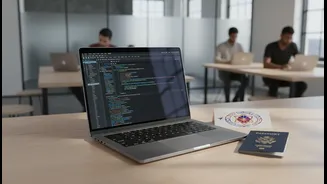









A Global Competition for Talent
In the post-pandemic world, a new global race is underway: the competition for digital nomads. These remote workers bring foreign currency, support local economies without taking local jobs, and often contribute to the local tech and creative scenes.
Southeast Asian nations have leaned into this trend aggressively. Countries like Thailand, Malaysia, and Indonesia have realised that attracting this new class of high-value, long-stay visitors is a powerful strategy for economic growth and diversification away from traditional tourism. They are proactively designing policies to lure remote professionals, viewing them as an asset.
Lower Financial Hurdles
One of the most significant differences lies in the financial requirements. Many European digital nomad visas, for instance, demand a substantial monthly income. Figures often range from €2,500 to €3,700 per month (approximately ₹2.2 lakh to ₹3.3 lakh) for popular destinations like Spain, Italy, and Croatia. Some, like Iceland, require even more. In contrast, Southeast Asian options are often more accessible. Malaysia's popular DE Rantau Nomad Pass requires an annual income of just USD 24,000 (about ₹20 lakh) for tech professionals. Thailand's new Destination Thailand Visa (DTV) has no monthly income requirement at all, instead asking for proof of savings of around USD 15,000 (about ₹12.5 lakh). This makes the dream a reality for a much wider range of professionals, not just high-earning executives.
Clarity and Purpose-Built Design
Western nations often lack specific visa categories for digital nomads. Remote workers trying to move to the US, for example, must navigate a complex web of existing visas—like the O-1 for 'extraordinary ability' or investor visas—none of which are designed for their situation. This creates ambiguity and a complicated, expensive application process. In Southeast Asia, the opposite is happening. Visas like Malaysia's DE Rantau and Indonesia's E33G are explicitly created for remote workers. The requirements are clearly stated, the application processes are often fully online, and the purpose is unambiguous: you are welcome here to work remotely for foreign companies. This clarity removes much of the stress and uncertainty involved in making an international move.
A Fundamental Difference in Philosophy
Ultimately, the contrast stems from a different philosophy. Many Western countries view long-term stays through the lens of traditional immigration, with systems designed to be highly selective and control population influx. The digital nomad is a new phenomenon that their legacy systems are not yet equipped to handle. Southeast Asian nations, however, see it primarily as an economic opportunity. They are building visa frameworks from the ground up to be attractive and competitive. They are not just permitting remote work; they are actively encouraging it as a pillar of their modern economic strategy. This mindset results in policies that are more welcoming, flexible, and fundamentally easier for the applicant to navigate.