







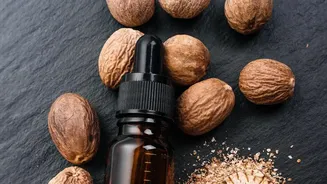
A Spice with a Storied Past
For centuries, nutmeg has been more than just a festive flavouring for pies and warm drinks. Traditional medicine systems, from Ayurveda in India to ancient Chinese practices, have valued it for a range of properties. It was used to aid digestion, reduce
inflammation, and, most intriguingly, as a remedy for mental fatigue and to 'lift the spirit'. This historical reputation as a natural mood enhancer and cognitive supporter is the foundation upon which modern brain-health claims are built. The core idea is that if a substance has been used for generations, there must be some truth to its effects. While tradition offers a fascinating starting point, it isn't scientific proof. It provides a hypothesis, an idea worth testing with modern methods to see if the claims hold up to scrutiny.
The First Rung: Lab and Animal Studies
Modern science often begins by taking traditional knowledge into the laboratory. Researchers have identified several active compounds in nutmeg, most notably myristicin and elemicin. In lab settings (in vitro) and in animal studies (in vivo), these compounds have shown some interesting properties. For instance, some research suggests nutmeg extracts have antioxidant effects that could, in theory, protect brain cells from damage. Animal studies, primarily in rodents, have suggested that certain nutmeg extracts might enhance memory and learning. However, this is where a crucial dose of scepticism is required. While promising, these studies are very preliminary. What happens in a petri dish or a mouse does not reliably predict what will happen in a human. The vast majority of findings from animal studies are never successfully replicated in people. They are a necessary early step, but they are not a conclusion.
The Human Element: Where's the Proof?
For a health claim to be considered strong, it needs to be backed by robust human clinical trials. The 'gold standard' is the randomized, placebo-controlled trial (RCT), where one group of people receives the substance being tested and a similar group receives a placebo, with neither the participants nor the researchers knowing who got what until the end. This design minimizes bias and helps prove cause and effect. When it comes to nutmeg and cognitive enhancement, the evidence from human trials is currently lacking. While there is extensive documentation of nutmeg's effects at high doses, these are not related to brain health but to its toxic and psychoactive properties. The existing research on nutmeg's potential brain-boosting benefits has not yet made the leap from animal models to large-scale human studies. Without these trials, any claim about improving memory or brain function remains speculative.
The Dose Makes the Poison
It is critical to discuss dosage, as nutmeg provides a stark example of a substance that is safe in one amount and dangerous in another. The pinch of nutmeg in your food is perfectly fine. However, at high doses—as little as two teaspoons, or about 10 grams—nutmeg can become toxic. The same compound, myristicin, that is studied for potential benefits is responsible for these toxic effects. Symptoms of nutmeg intoxication can include intense nausea, dizziness, confusion, a rapid heart rate, and hallucinations. These adverse effects, which can last for many hours, appear after ingesting amounts far greater than anyone would use in cooking. This highlights a key principle of wellness: more is not always better. A substance's safety and efficacy are entirely dependent on the dose.
Your Toolkit for Evaluating Health Claims
The case of nutmeg serves as a perfect lesson in how to approach any brain-health claim. Before you believe the hype, run through this mental checklist: 1. What's the evidence? Is the claim based on traditional use, animal studies, or human clinical trials? Remember that human trials provide the strongest proof. 2. Who was studied? If there are human studies, were there ten participants or a thousand? Large, well-designed studies are more reliable. 3. What was the dose? Is the amount used in the study realistic and safe for everyday consumption? 4. Has it been replicated? Has more than one independent research group found the same result? A single study is rarely the final word. 5. Is it too good to be true? Claims of a 'miracle cure' or a 'secret formula' are red flags. Legitimate science is usually more measured and cautious. Applying this critical lens helps you move from being a passive consumer of information to an empowered and informed sceptic.