






Long before 'upcycling' became a global buzzword, Indian artisans were mastering the art of transforming the old into something new and beautiful. Three traditions in particular—Sujini, Kantha, and Chindi—embody this spirit of creative reuse.
Sujini: The Narrative Quilts of Bihar
Originating
from the Bhusura village in Bihar, Sujini (or Sujani) is a craft born from necessity and affection. Traditionally, women would layer worn-out cotton saris and dhotis to create soft, warm quilts for newborn babies. The name itself combines 'su' (easy) and 'jani' (birth). What began as a practical way to reuse old cloth evolved into a powerful storytelling medium. The layers of fabric are held together by a fine running stitch, which also forms the basis for intricate embroidered motifs. These designs are not merely decorative; they are narrative tapestries depicting folklore, village life, personal dreams, and social issues. The motifs are often outlined with a chain stitch in a dark colour, with the background and fillings created using running stitches, lending the pieces a unique visual texture. This practice of turning discarded textiles into a canvas for personal and communal stories is a profound example of early upcycling, where value is added through skill, creativity, and love.
Kantha: The Signature Stitch of Bengal
Kantha is one of India's most ancient and treasured embroidery traditions, with roots in West Bengal and Bangladesh. The word 'Kantha' is derived from the Sanskrit 'kontha', meaning rags, which points directly to its origin as a method of recycling. Similar to Sujini, Kantha involves layering old saris or dhotis to create quilts, covers, and other household items. The primary technique is the simple yet versatile running stitch, which creates a distinctive wrinkled, puckered texture across the fabric surface. This stitch is used to join the layers and to create elaborate motifs, often drawn from nature, mythology, and daily life. Unlike Sujini, where stitches are typically in straight lines, Kantha embroidery can be worked in any direction, often spiralling or circling around a central motif. Traditionally, even the threads for embroidery were pulled from the borders of old saris. From humble, utilitarian quilts, Kantha has evolved into a globally recognised art form, gracing everything from high-fashion garments to decorative wall hangings, all while retaining its soul of resourcefulness.
Chindi: Weaving Wonders from Waste
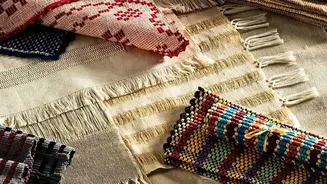
While Sujini and Kantha are embroidery-based, Chindi is a craft of weaving or braiding. The name 'Chindi' literally means 'torn cloth' or 'fabric scrap'. This tradition makes use of the smallest leftover pieces from the tailoring process or end-of-life garments that would otherwise be discarded. Women traditionally collected these colourful fabric scraps and transformed them into yarn, which was then woven, knitted, or crocheted into durable and vibrant products like rugs (dhoti), mats, bags, and baskets. The beauty of Chindi lies in its kaleidoscopic, unplanned aesthetic; since the scraps are of various colours and textures, no two Chindi products are ever identical. Today, the craft has moved beyond the household and is providing a sustainable solution for post-industrial textile waste from factories. It has become a means of livelihood for many artisans and a powerful example of a zero-waste, circular economy in action, turning literal trash into treasure.
A Shared Philosophy, Distinct Expressions
Though they originate from different regions and employ different techniques, Sujini, Kantha, and Chindi are united by a common philosophy of thrift and ingenuity. All three were born from a world where nothing was wasted, and every piece of cloth was valued. Sujini uses embroidery on layered cloth to tell intimate stories. Kantha uses the running stitch to give old fabrics new life with rich textures. Chindi takes the most fragmented textile waste and weaves it into functional, colourful goods. Sujini's stitch work is often linear and narrative-focused, while Kantha's is more fluid and textural. Chindi, on the other hand, is not about stitching onto a surface but creating a new fabric from scraps. Together, they represent a spectrum of upcycling—from repurposing whole garments to recycling the tiniest fragments—that feels more relevant today than ever.