





The Sun's Fiery Crown
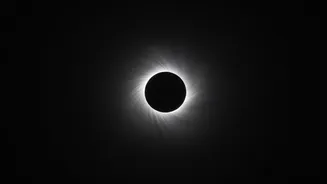
The star of the show during a total eclipse is the solar corona. This is the Sun's outermost atmosphere, a wispy, ethereal halo of plasma (super-heated gas) that stretches millions of kilometres into space. Normally, the corona is completely invisible
to us. It is about a million times dimmer than the Sun's bright surface, the photosphere, meaning it gets totally washed out by the star's intense glare. A total solar eclipse provides a unique solution. The Moon, by a remarkable cosmic coincidence, appears just the right size in our sky to act as a perfect natural shield, blocking the photosphere and allowing the faint, pearly light of the corona to shine through in all its glory.
A Million-Degree Mystery
One of the longest-standing puzzles in solar physics is the coronal heating problem. The Sun's surface is a blistering 5,500 degrees Celsius. Logic suggests that as you move further away from a heat source, it should get cooler. Yet, the corona sizzles at temperatures of over 1 million degrees Celsius, hundreds of times hotter than the surface far below it. Understanding how this happens is a key goal for solar physicists. Theories range from constant, tiny explosions called 'nanoflares' peppering the Sun's surface to energy being transferred by complex magnetic waves. Totality allows scientists to gather crucial data from the innermost region of the corona, where this heating mechanism is believed to originate.
The Scientific Rush of Totality
When the Moon's shadow falls, teams of scientists around the world spring into action. They use specialized instruments called spectrographs to break down the corona's light, which tells them about its temperature, density, and chemical composition. By analysing the light, they can identify highly ionized elements like iron, which can only exist at the extreme temperatures found in the corona. They also capture high-resolution images to map the intricate structures within the corona—loops, streamers, and plumes—which are all shaped by the Sun’s powerful and complex magnetic fields. These few minutes of observation provide a detailed snapshot that helps piece together the larger puzzle of the Sun’s behaviour.
Connecting Corona to Cosmos and Communication
Studying the corona isn't just about understanding a distant star; it has direct implications for us on Earth. The corona is the source of the solar wind, a continuous stream of charged particles that flows out and fills the solar system. This is the engine of space weather. Violent events in the corona, known as Coronal Mass Ejections (CMEs), can send huge clouds of plasma hurtling towards Earth, potentially disrupting our satellites, power grids, and communication systems. By studying the corona during an eclipse, scientists can better understand the origin of these events and improve our ability to predict space weather.
Beyond the Eclipse: India's Eye on the Sun
While eclipses offer a rare glimpse, continuous monitoring is needed. This is where artificial eclipses, created by instruments called coronagraphs, come in. These devices are used on both ground-based telescopes and space missions. Taking this a step further, India's own Aditya-L1 mission, positioned 1.5 million km from Earth, is dedicated to studying the corona. Its advanced coronagraph can observe the Sun continuously, providing crucial data on CMEs and helping to unravel the coronal heating mystery. Recent findings from Aditya-L1 have already provided strong evidence suggesting that energy from the Sun's reconfiguring magnetic fields is a primary source of the corona's intense heat. Together, the fleeting minutes of a natural eclipse and the constant watch of missions like Aditya-L1 are helping us unlock the Sun's most enduring secrets.