






A Long-Distance Call Home
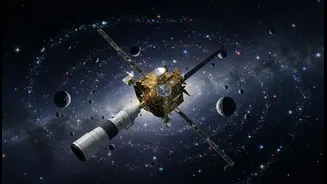
On July 7, 2026, after a journey of nearly 6 billion miles, a signal confirming the probe was healthy and operational reached mission controllers at the Johns Hopkins Applied Physics Laboratory. The message, traveling at the speed of light, took around
nine hours to cross the vast distance, marking the end of the spacecraft's longest-ever hibernation period. This power-saving nap began in August 2025, a standard practice for the mission to conserve its limited resources and reduce wear and tear on its critical systems during the long cruise through the Kuiper Belt. While mostly dormant, the probe wasn't entirely inactive; several instruments continued to passively collect data on the charged-particle and dust environment, turning the long sleep into a productive scientific stakeout. Now, as it comes fully awake, New Horizons begins the slow process of transmitting that treasure trove of data back to Earth before starting its new active duties.
An Unparalleled Vantage Point
New Horizons’ location is what makes this moment so significant. Launched in 2006, it completed the initial reconnaissance of the classical planets with its historic flyby of Pluto in 2015, before venturing onward. In 2019, it made history again by visiting Arrokoth, the most distant object ever explored up close. Since then, it has been traveling through the Kuiper Belt, a donut-shaped region of icy bodies left over from the formation of the solar system. Being the only spacecraft to ever operate in this region gives it a perspective that is simply impossible to get from Earth. While powerful new observatories like the Vera C. Rubin Observatory in Chile are set to discover tens of thousands of new Kuiper Belt Objects (KBOs), they can only see them as faint points of light. New Horizons can study these objects from much closer, observing their surface properties, shapes, and the way they reflect light at angles we can't see from home, providing vital ground truth to the flood of new discoveries.
Assembling the Solar System’s Blueprint
This is the essence of next-generation Kuiper Belt mapping: combining the sheer quantity of discoveries from Earth with the high-quality, in-situ data from New Horizons. The Kuiper Belt is often called a scientific fossil record, its icy inhabitants holding clues to the formation and evolution of our entire planetary system. By studying the orbits, compositions, and distribution of these primordial worlds, scientists can piece together the solar system's chaotic youth. New Horizons acts as a remote surveyor in this vast, frozen wilderness. Mission scientists even use artificial intelligence to scour images from ground-based telescopes, finding faint KBOs near the spacecraft's path for it to observe. This synergy allows us to build a far more detailed and accurate map of this third zone of the solar system, moving from a simple census of objects to a deep understanding of its structure and history.
Beyond the Belt
The mission's renewed activity isn't just about mapping KBOs. The spacecraft is a multi-purpose science platform operating in a barely explored frontier. One of its first new tasks will be to use its ultraviolet spectrograph to study the distribution of hydrogen at the edge of the heliosphere—the vast bubble of charged particles blown outward from the sun. This data provides a crucial link between the observations of the two Voyager probes, which have already crossed into interstellar space, and our models of the boundary that separates our solar system from the rest of the galaxy. As it continues its journey at nearly 300 million miles per year, New Horizons provides a steady stream of data on the environment of deep space, informing how we design future missions destined to travel even farther. With its nuclear power source slowly decaying, the mission is expected to continue returning data until it exits the Kuiper Belt entirely sometime around 2028 or 2029.