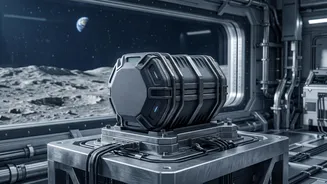




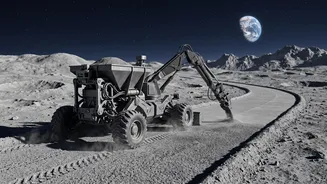
Meet the New Lunar Workforce
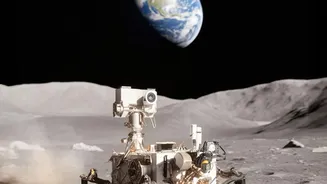
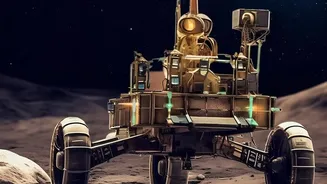
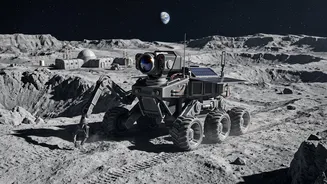
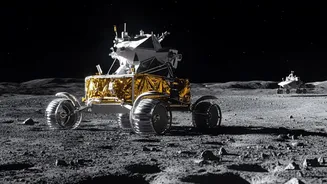
NASA is pioneering this push with a technology demonstration called CADRE, which stands for Cooperative Autonomous Distributed Robotic Exploration. The mission involves sending a trio of small rovers, each about the size of a carry-on suitcase, to the Moon.
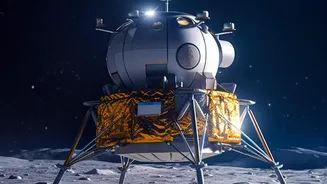
Scheduled to launch aboard a commercial lander in 2026, these rovers will spend a full lunar day—about 14 Earth days—working together in the Reiner Gamma region. Their goal is to prove that a team of robots can autonomously explore, map, and conduct science without constant step-by-step commands from mission control back on Earth. This marks a fundamental shift from the single, human-controlled rovers of the past to a new era of robotic teamwork.
The Power of the Swarm
So, why send a team instead of one large, capable rover? The answer lies in the power of collaboration and redundancy. A multi-robot system can cover more ground and accomplish tasks that are impossible for a single agent. For instance, the CADRE rovers will use ground-penetrating radar to create a 3D map of the lunar subsurface. By taking simultaneous measurements from different points, they can gather data with a richness and depth that one rover alone could not achieve. Furthermore, if one rover in a swarm fails, the mission isn't over. The team can adapt and continue its work, providing a level of resilience that is critical for high-stakes space missions.
How Robots Learn to Cooperate
The secret sauce behind this coordination is advanced autonomy software developed at NASA's Jet Propulsion Laboratory. The rovers won't be remote-controlled with joysticks. Instead, they will receive high-level objectives from Earth, like 'map this designated area'. From there, the team takes over. The rovers will elect a 'leader,' divide tasks among themselves, and navigate the terrain as a cohesive unit. They communicate with each other and a base station on the lander through a mesh network radio system. This distributed intelligence allows each robot to make its own decisions, like avoiding a small obstacle, while still working toward the group's shared goal. During ground tests, the system has already proven its robustness: when one rover ran low on power, the entire team paused its work to wait for it.
Overcoming Lunar Challenges
Operating on the Moon is incredibly difficult. Robots must endure extreme temperatures, abrasive lunar dust, and intense radiation. The lack of a GPS-like system means rovers must navigate using their own onboard sensors and cameras. Communication is another hurdle; direct line-of-sight to Earth isn't always possible, especially in the promising but treacherous regions of the lunar South Pole. Autonomous swarms are a potential solution to this, as they can operate for extended periods without human intervention, ducking into shadowed craters where communications might be cut off. The CADRE mission is designed specifically to test these capabilities in a real lunar environment, paving the way for more ambitious exploration.
The Blueprint for a Lunar Future
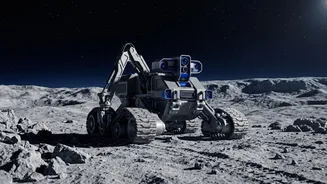
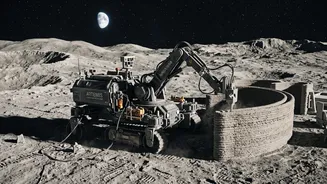
The success of CADRE and similar projects could unlock the next phase of space exploration. These robotic teams are not intended to replace astronauts, but to work alongside them as an invaluable support crew. They could perform dangerous or repetitive tasks like scouting locations, transporting equipment, and even beginning the construction of habitats and infrastructure before humans arrive. This frees up astronauts to focus on complex scientific research and discovery. As humanity looks to establish a sustained presence on the Moon under programs like Artemis, and eventually move on to Mars, these collaborative robotic systems will no longer be an experiment—they will be an essential part of the business of space.