







What is the LEO Gold Rush?
Low-Earth Orbit is the region of space up to 2,000 kilometres in altitude, close enough for relatively quick access and constant communication. For decades, its primary residents were government-run assets like the International Space Station (ISS). But
a dramatic drop in launch costs, pioneered by companies like SpaceX, has blown the airlock wide open for commercial ventures. This has ignited a modern-day gold rush. The broader space economy, valued at around $600 billion, is projected to triple to over $1.8 trillion by 2035. A huge slice of that growth is happening in LEO. Private investment in space tech hit a record $12.4 billion in 2025, signaling a shift from speculative bets to funding proven, revenue-generating businesses.
The Race for Global Connectivity
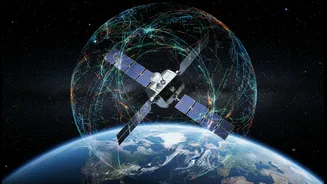
The most mature and visible sector in the LEO economy is satellite internet. Companies like SpaceX's Starlink and OneWeb are deploying vast constellations of thousands of small satellites to beam high-speed internet to every corner of the globe. These services are already connecting remote communities, airplanes, and ships that terrestrial networks can't reach. The demand is massive; fixed broadband penetration is still below 40% in Africa and 80% in Asia-Pacific and Latin America. This market is not just about connecting homes. It's becoming the backbone for the next wave of the AI economy, providing the low-latency, continuous connectivity required for autonomous vehicles, industrial robotics, and smart grid management that 5G can't fully support. The LEO services market, valued at about $16 billion in 2025, is forecasted to explode to $120 billion by 2030.
Beyond Internet: New Industries in Orbit
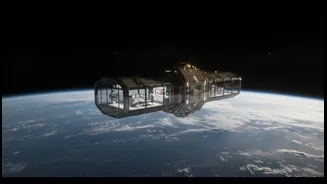
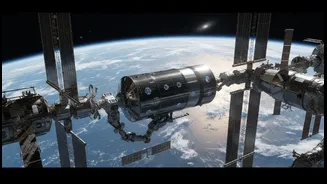
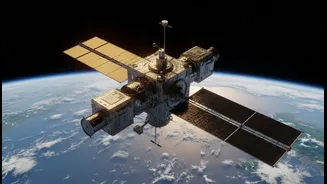
While connectivity grabs headlines, a diverse ecosystem of new industries is emerging in LEO. One key area is Earth Observation (EO). Companies like Planet Labs operate constellations that provide high-resolution imagery and data for agriculture, climate monitoring, and defense. Another revolutionary field is in-space manufacturing. The microgravity environment allows for the creation of unique materials, from flawless fiber optics to purer semiconductor crystals and advanced pharmaceuticals, that are impossible to produce on Earth. Companies like Varda Space Industries are already demonstrating this potential, with one mission involving pharmaceutical processing in orbit. Furthermore, with the ISS scheduled for retirement around 2030, a race is on to build commercial space stations. Companies like Axiom Space, Blue Origin, and Starlab are developing private outposts to serve as research labs, manufacturing hubs, and even tourist destinations.
Navigating the Frontier's Challenges
This new frontier is not without significant risks and challenges. The sheer number of satellites is creating a massive space debris problem. A single collision could set off a catastrophic chain reaction, known as the Kessler Syndrome, that could render LEO unusable. The regulatory landscape is another major hurdle. International space law was written for nations, not private companies, creating uncertainty around liability and resource management. Finally, despite falling launch costs, operating in space remains incredibly capital-intensive. Building a commercial space station or a satellite constellation requires billions in upfront investment, and the path to profitability is still being mapped out. Companies must balance innovation with the harsh realities of building resilient infrastructure in an unforgiving environment.