






India's agriculture faces the twin challenges of water scarcity and rising energy demands. Now, an elegant solution is emerging from its fields and canals: installing solar panels over crops to generate clean power and save precious water.
A Double Win for Farmland
Imagine a farm
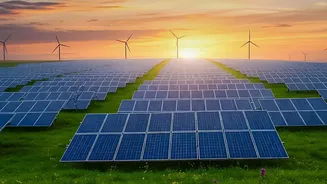
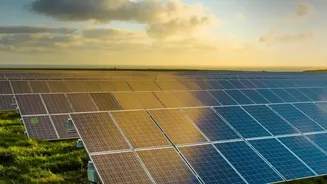
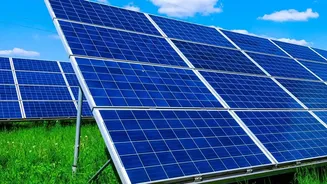
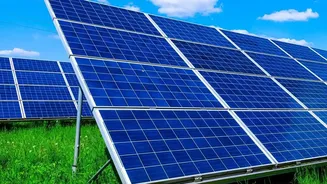
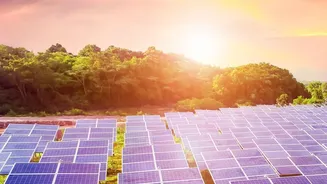
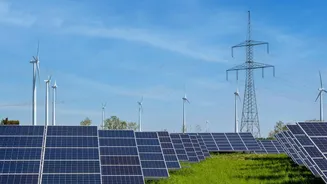
that harvests not just crops, but sunshine as well. This is the core idea behind 'agrivoltaics', a system where solar panels are mounted on structures high enough to allow farming to continue underneath. Instead of dedicating separate tracts of land for agriculture and solar energy, this dual-use model combines them. For a country where land is a precious resource, this approach tackles two critical needs at once: achieving India's renewable energy goals without compromising food security. Panels are installed high enough for tractors and other machinery to pass freely, allowing farmers to cultivate their land as usual while generating a new stream of income from electricity.
How It Saves Precious Water
The most significant benefit, especially in arid and semi-arid regions, is water conservation. The shade provided by the overhead solar panels lowers the temperature of the soil and crops, which significantly reduces the rate of water evaporation. Studies and pilot projects across India have shown that this shading effect can reduce the need for irrigation by up to 30%. In a project in Sagar, Madhya Pradesh, a 30-40% reduction in crop water evaporation was recorded. This is a game-changer for Indian agriculture, which is heavily dependent on monsoons and groundwater. The concept has also been applied to India's extensive canal network. A pioneering project over the Narmada canal in Gujarat saves an estimated 9 million litres of water annually by preventing it from evaporating under the hot sun.
More Than Just Power and Water
The advantages of agrivoltaics extend beyond energy and water. The partial shade can protect certain crops from extreme heat stress, leading to improved yields for shade-tolerant species like tomatoes, spinach, herbs, and various vegetables. Farmers gain a diversified and more stable income, earning from both their crops and by selling surplus solar power to the grid, often supported by government schemes like PM-KUSUM. This dual revenue stream provides a crucial economic buffer against crop failures or market fluctuations. Furthermore, the cooler microclimate under the panels has been observed to improve the efficiency of the solar modules themselves, creating a symbiotic relationship where both farm and panel perform better.
Pioneering Projects Across India
While still in its early stages, agrivoltaics is gaining traction across the country. Gujarat led the way with one of the world's first canal-top solar projects back in 2012, a 1 MW plant on the Narmada canal that set a global example. Since then, numerous pilot projects have sprung up. In Sagar, Madhya Pradesh, India's largest agrivoltaics project demonstrates how over 13 crop varieties can thrive under solar panels. Research in the Tehri district of Uttarakhand is exploring the cultivation of medicinal plants in these shaded microclimates. These projects in states like Maharashtra, Rajasthan, and Punjab are providing crucial data and building confidence among farmers and developers, proving the model's viability in diverse agricultural contexts.
The Challenges and Road Ahead
Despite its immense potential, scaling up agrivoltaics in India faces hurdles. The primary challenge is the higher upfront cost, with elevated mounting structures making these projects 25–40% more expensive than conventional ground–mounted solar farms. This can be a significant barrier for India's small and marginal farmers. Not all crops are suitable for cultivation under shade; staples like rice and sugarcane have not been found to be compatible. There are also technical challenges related to cleaning and maintaining panels installed high above the ground, and in many rural areas, the local electricity grid may not be robust enough to handle the influx of solar power. Addressing these issues through policy support, financial incentives, and further research into crop suitability is crucial for the widespread adoption of this promising technology.