
A New Geometric Wonder
Saturn, the ringed jewel of our solar system, has a new surprise for astronomers. Recent observations from NASA's Hubble Space Telescope have identified a giant, ten-sided atmospheric wave, or 'decagon', encircling the planet's south pole. This is the first
time a large, regular-sided jet pattern has been seen in the planet's southern hemisphere. For years, scientists have been captivated by the enduring hexagonal storm system at Saturn's north pole, a feature that has been stable for over 40 years. The discovery of a southern counterpart raises fascinating questions about the planet's atmospheric symmetry and dynamics. This new decagon appears to be strengthening, giving scientists a rare and exciting opportunity to watch a massive planetary weather system develop in real time.
Hubble's Patient Vigil
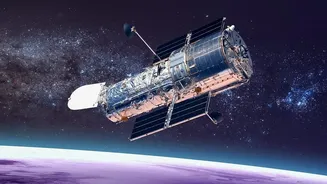
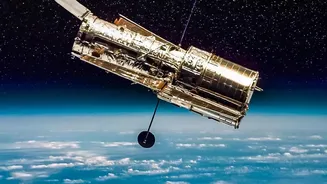
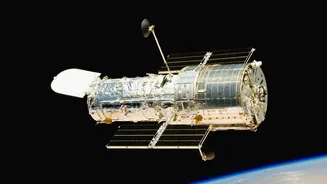
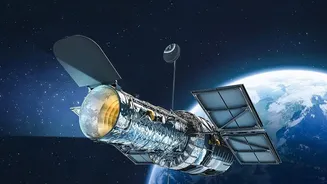
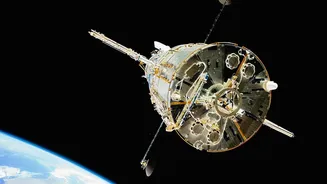
This discovery was made possible by Hubble's long-term commitment to observing our solar system's giants. The observations were part of the Outer Planet Atmospheres Legacy (OPAL) program, which began in 2014 to create a consistent, long-term database of the outer planets' dynamic atmospheres. By capturing annual images, OPAL allows researchers to track seasonal changes and evolving weather patterns that would otherwise be missed. As Saturn's 29-year orbit around the sun causes its seasons to change, the south pole, which had been tilted away from Earth, gradually came back into view. Scientists, reviewing Hubble data stretching back to 2023, were able to find faint hints of the structure before it became a more clearly defined pattern in recent images. This long-term monitoring, combined with Hubble's sharp vision from above Earth's blurry atmosphere, was crucial to confirming the decagon's existence.
An Evolving Mystery
What makes this southern decagon so unusual is not just its existence, but its behaviour. Unlike the famously persistent northern hexagon, this ten-sided feature appears to be a recent development. Data from NASA's Cassini spacecraft, which orbited Saturn from 2004 to 2017, showed no sign of such a formation. This suggests the decagon formed sometime after Cassini's mission ended. According to Amy Simon, the principal investigator for the OPAL program, the fact that it seems to have formed so recently is the most intriguing part of the discovery. Researchers also note that the pattern extends deep into Saturn's atmosphere, indicating it is a significant, vertically extended structure, not just a surface-level cloud pattern.
Why This Polar Pattern Matters
Observing the birth of a massive atmospheric structure like this is a goldmine for planetary scientists. It provides a natural laboratory for testing theories about the fluid dynamics that govern the atmospheres of gas giants. For years, researchers wondered why the north pole had a stable polygon while the south pole did not. This new decagon suggests that such features may be more common than previously thought, perhaps forming and dissipating with the long, seven-year-long Saturnian seasons. By continuing to monitor the decagon's evolution, scientists hope to answer key questions: Why did it form now? How long will it last? Will it stabilise into a long-lived feature like its northern sibling? Understanding these processes on Saturn can provide insights into the weather systems on Jupiter, Uranus, and Neptune, and even on planets orbiting other stars.