



A Celestial Identity Crisis
Imagine a typical resident of the main asteroid belt, a vast region of space between Mars and Jupiter. For billions of years, it has been orbiting the Sun as a quiet, unassuming chunk of rock and metal. Then, one day, astronomers notice something has changed.
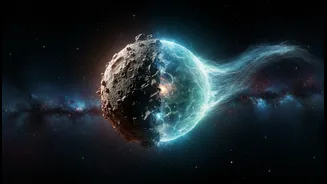
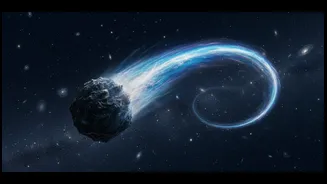
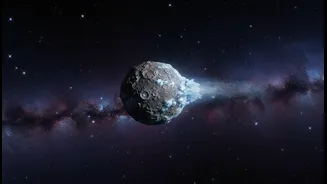
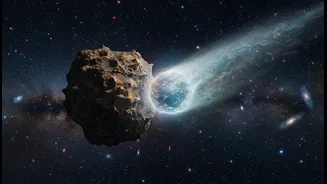
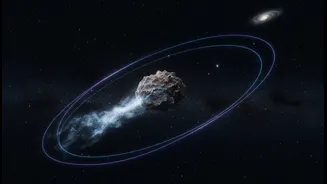
The rock, once just a faint point of light, now has a fuzzy halo and a faint tail trailing behind it. This is the puzzle presented by objects known as 'active asteroids' or 'main-belt comets'. One such object, (248370) 2005 QN173, has captured scientific attention. It lives in the asteroid belt and has an asteroid's orbit, yet it has been observed sprouting a tail, behaving like a comet. This behaviour challenges the classic, clean-cut division between rocky asteroids and icy comets.
Clue 1: The Tell-Tale Tail
The most obvious sign that a space rock is not inactive is the appearance of a tail or a glowing cloud of gas and dust called a coma. Traditionally, this is the signature of a comet. Comets are often called "dirty snowballs" because they are made of ice, dust, and rock. When their long, elliptical orbits bring them close to the Sun, the heat vaporises their ice, releasing gas and dust that gets pushed back by solar wind and radiation pressure, forming spectacular tails. Asteroids, having formed closer to the Sun, are mostly rock and were thought to have no ice to sublimate. So when an object with an asteroid's address starts displaying a comet's tail, it's a major clue that something more is going on. For 2005 QN173, observations confirmed a dust tail that persisted for months, proving its activity was more than a fleeting event.
Clue 2: An Orbit Out of Place
An object's orbit is a crucial piece of its identity card. Scientists determine an orbit by taking multiple images over time and calculating the object's path around the Sun. This reveals its history and origin. Comets typically have highly elongated, or eccentric, orbits that take them from the freezing outer solar system (the Kuiper Belt or Oort Cloud) into the warmer inner regions and back out again. Most asteroids, on the other hand, have more circular orbits and reside peacefully in the main belt. Active asteroids like 2005 QN173 are confounding because they have the orbit of an asteroid—a near-circular path firmly within the main belt—but the physical appearance of a comet. This suggests they may be native to the asteroid belt, not visitors from the outer solar system, forcing a rethink of how water and ice are distributed.
Clue 3: The Hunt for Volatiles
The key to this mysterious activity lies in 'volatiles'—substances like water ice that turn into gas at low temperatures. The activity on these hybrid objects is believed to be driven by the sublimation of buried ice, which has somehow been exposed to sunlight. This could happen after a collision with another small asteroid excavates the surface, uncovering a pristine icy layer beneath a protective crust of dust. Scientists study the light reflected from the coma and tail—a technique called spectroscopy—to analyse its composition. While studies of 2005 QN173 did not reveal obvious gas emissions, the presence of a dust tail strongly implies that some process, likely sublimation, is lifting dust off the surface. These volatiles are the smoking gun that connects the object's cometary behaviour to its physical makeup.
Why These Hybrids Matter
Solving the mystery of these supposedly inactive rocks is about more than just reclassifying a few oddballs. These active asteroids are blurring the lines in our solar system's family portrait and could be a crucial missing link in understanding the origins of life on Earth. Scientists have long debated how our planet, which formed in a hot, dry region of the solar system, got its water. One leading theory is that it was delivered by impacts from icy bodies. While comets from the outer solar system were long considered the prime suspects, their chemical fingerprint doesn't quite match Earth's oceans. The discovery of icy bodies in the much closer asteroid belt provides a new, and possibly more plausible, source for Earth's water. These objects are essentially time capsules from the early solar system, holding clues about its formation and the ingredients that make a planet habitable.