






A Junkyard Above Our Heads
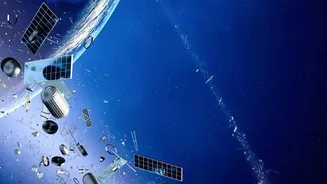
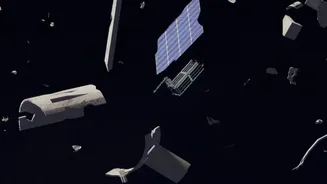
Space may seem vast and empty, but the region just above our atmosphere is becoming alarmingly cluttered. Decades of satellite launches, rocket stages, and mission-related debris have created a high-speed junkyard in Low Earth Orbit (LEO). Experts estimate
there are millions of objects smaller than 10 cm, and hundreds of thousands of larger ones, all whipping around the planet at speeds exceeding 27,000 kilometres per hour. At that velocity, even a fragment the size of a marble can strike with devastating force, capable of disabling a multi-million-dollar satellite. This growing threat isn't just theoretical; it’s an active danger. In 2025 alone, the Indian Space Research Organisation (ISRO) had to perform a record 140 collision avoidance manoeuvres to safeguard its space assets, with nine more executed in the first half of 2026. The problem is clear: dodging space bullets is becoming a full-time job.
Why Protecting India's Satellites Matters
For India, the stakes are incredibly high. The nation operates a sophisticated fleet of Earth-observation satellites that form the backbone of its modern infrastructure. These assets are crucial for everything from agricultural planning and weather forecasting to disaster management and national security. Of India's 22 active satellites, 20 are in the crowded LEO region, placing them at significant risk. These aren't just scientific instruments; they are strategic national assets. Manually tracking threats and firing thrusters to move a satellite out of harm's way is a costly and resource-intensive process. Each manoeuvre consumes precious fuel, shortening a satellite's operational lifespan, and requires constant vigilance from ground control. As the orbital environment becomes more congested, a more autonomous and intelligent solution is not just a convenience—it's a necessity.
The Rise of the Smart Shield
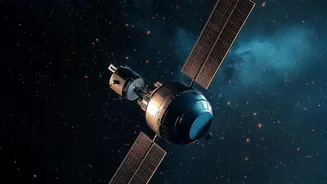
This is where Indian innovation comes into play. The concept at the heart of the headline combines two key technologies: advanced space situational awareness (SSA) and intelligent propulsion systems. Startups like Bengaluru-based Digantara are developing sophisticated AI-driven surveillance systems, both on the ground and planned for space, to create a comprehensive map of orbital traffic. Their systems use AI to autonomously scan the sky, distinguishing between satellites, debris, and stars to identify potential threats in near real-time. On the other side of the equation are propulsion specialists like Bellatrix Aerospace, another Indian startup, which designs high-efficiency thruster systems for satellites. The goal is to integrate these two capabilities. The vision is for an AI algorithm, fed by constant data from surveillance systems, to be installed directly onto future satellites. This onboard brain would be able to detect an impending collision and automatically command the thrusters to execute a precise avoidance manoeuvre without human intervention.
How Autonomous Collision Avoidance Works
The process is a leap forward from current methods. Today, ground stations track potential threats and, if a collision seems likely, engineers calculate a new course and command the satellite to fire its thrusters. An AI-powered system would make this process autonomous. The system would continuously analyse data streams, predicting the trajectory of nearby debris. If the AI determines a high probability of a collision, it would calculate the most efficient dodge—factoring in fuel consumption and mission objectives. It would then automatically engage the satellite’s electric propulsion system, like the Hall-effect thrusters developed by Bellatrix Aerospace, to make a small, precise adjustment to its orbit, navigating it to safety. This not only frees up human operators but also enables much faster reaction times, which is critical when objects are closing in at hypersonic speeds. ISRO has already demonstrated autonomous docking capabilities, a key technological step towards fully independent satellite operations.
Pioneering a Sustainable Future in Space
This move towards AI-driven protection is part of India’s broader strategy for sustainable space operations. ISRO has announced its 'Debris Free Space Mission' initiative, aiming for all Indian space actors to achieve zero debris contribution by 2030. Developing autonomous collision avoidance systems is a major pillar of this vision. By making satellites smarter and more self-sufficient, India is not only protecting its own billion-dollar investments but also positioning itself as a global leader in responsible space management. This technology ensures that satellites can operate longer and more reliably, even as orbit becomes more hazardous. It represents a critical shift from simply reacting to threats to proactively and intelligently managing the space environment, securing India's strategic and economic interests for decades to come.