




The Grand Objective: A Lunar Souvenir for Science
Chandrayaan-4 is India's first attempt at a lunar sample-return mission. The goal is to collect rock and soil from the Moon's surface, seal it, and transport it safely back to Earth for detailed scientific analysis. If successful, India will join an exclusive
club of nations — including the United States, the former Soviet Union, and China — that have accomplished this feat. The mission aims to retrieve approximately two to three kilograms of lunar material, which will be invaluable for studying the Moon's origin, composition, and potential resources like water ice. This endeavour represents a monumental leap in complexity from previous missions, requiring new technologies and a flawlessly executed series of manoeuvres.
A Symphony of Five Modules
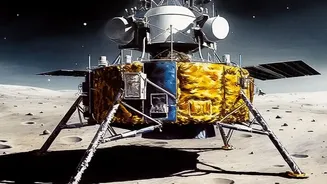
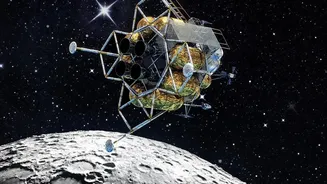
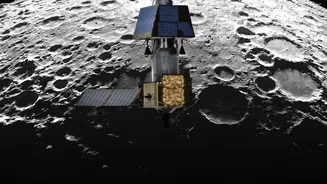
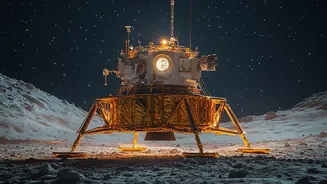
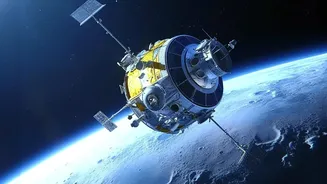
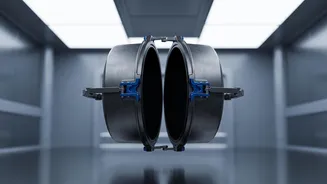
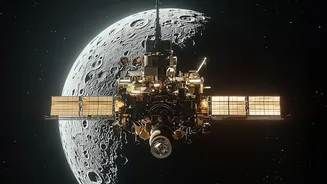
Unlike Chandrayaan-3, which had three main components, Chandrayaan-4 is a far more intricate spacecraft composed of five separate modules. Each has a specific and critical role to play in the mission's success. The five modules are the Propulsion Module (PM), Descender Module (DM), Ascender Module (AM), Transfer Module (TM), and Re-entry Module (RM). The Propulsion Module will do the heavy lifting for the initial journey to the Moon. The Descender Module, similar to the Vikram lander, is designed for a soft landing. The Ascender Module is a small rocket designed to lift off from the lunar surface with the samples. The Transfer and Re-entry modules work together to bring the precious cargo back home.
Two Rockets, One Mission
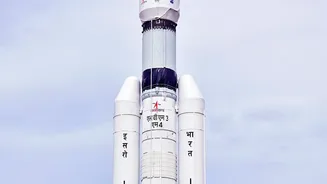
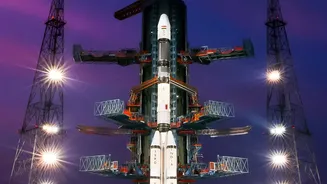
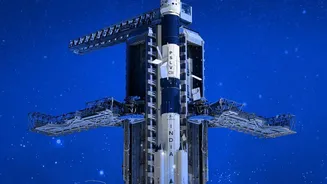
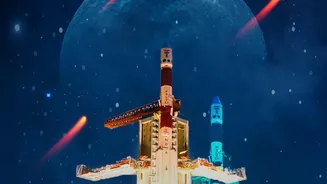
The sheer weight and complexity of these five modules mean that a single launch isn't feasible with India's current rocket fleet. The entire Chandrayaan-4 spacecraft is too heavy for even ISRO's most powerful rocket, the LVM3, to lift in one go. Therefore, ISRO has devised a dual-launch strategy. Two separate LVM3 rockets will be used. The first rocket will carry one stack of modules (the Descender and Ascender), and the second rocket will launch the other three (Propulsion, Transfer, and Re-entry). These two stacks will then meet and dock in Earth's orbit — a first for ISRO — before beginning their journey to the Moon as an integrated spacecraft.
The Surface Mission: Landing, Drilling, and Lifting Off
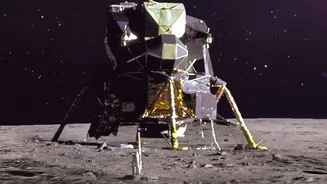
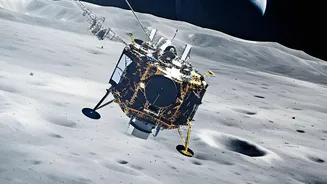
Once in lunar orbit, the combined Descender and Ascender modules will separate and begin their powered descent to the Moon's surface. After a successful soft landing, the mission's surface operations will commence. A robotic arm will collect samples from the surface, while a drill will gather material from beneath the regolith. These samples will be carefully transferred and sealed inside the Ascender Module. Once the collection is complete, the Ascender will use the Descender as a launchpad and fire its engine to lift off from the Moon, carrying the lunar soil and rocks back into orbit.
The Final Act: Rendezvous and Return to Earth
While the landing and ascent happen, the Transfer and Re-entry modules will be waiting in lunar orbit. The Ascender must perform another delicate operation: autonomously docking with the orbiting Transfer Module. The sample container will then be transferred from the Ascender to the Re-entry Module, which is designed to protect it during the fiery journey through Earth's atmosphere. Once the transfer is secure, the Transfer Module will fire its engines, pushing the Re-entry Module on a path back to Earth for a safe landing, completing one of the most complex space missions India has ever undertaken.