

A World of Water
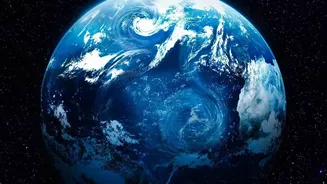
The most straightforward reason for Earth’s blue appearance is the simplest: our planet is covered in water. Oceans make up about 71% of the Earth's surface. When sunlight, which is made of a spectrum of colours, hits the ocean, the water molecules absorb
longer wavelengths of light, like reds, oranges, and yellows, more strongly than shorter wavelengths. Blue light, having a shorter wavelength, is less likely to be absorbed. Instead, it gets scattered and reflected back, making the vast oceans appear blue to any observer in space. So, in large part, the 'Blue Planet' owes its famous colour to its massive, deep blue seas.
The Atmosphere's Crucial Role
But water is only half the picture. Earth's atmosphere also plays a critical role, thanks to a phenomenon called Rayleigh scattering. Our atmosphere is full of tiny gas molecules, mostly nitrogen and oxygen. As sunlight enters the atmosphere, these molecules act like tiny scattering agents. They are far more effective at scattering short-wavelength light (like blue and violet) than long-wavelength light (like red and orange). This scattered blue light goes in all directions. From the ground, this is why our sky looks blue on a clear day. From space, this same scattered blue light contributes to the planet's overall blue halo.
Water and Air: A Team Effort
It's the combination of these two effects—the selective absorption and reflection by the oceans and the scattering of light by the atmosphere—that creates the signature blue marble effect. While some have argued one is more important than the other, the reality is that they work together. If you took away the atmosphere, our planet would still look blue because of the oceans, but it would be a much darker, inky blue. Conversely, if you took away the oceans and left only land, the atmospheric scattering would still give the planet a blueish tint, particularly around the edges, but the dominant colours would be the browns and greens of the continents. The two processes are distinct but their visual effects from space are cumulative.
What About the Other Colours?
Of course, Earth isn't just blue. The brilliant white swirls we see are clouds. The water droplets or ice crystals in clouds are much larger than the air molecules responsible for Rayleigh scattering. Because of their size, they scatter all wavelengths of light more or less equally, a process called Mie scattering. When all the colours of light are scattered together, the result is white. This is why clouds appear so bright and white from space. We also see the greens of forests and the browns and tans of deserts and mountains, which are the colours of the land surfaces themselves reflecting sunlight through the atmosphere. And finally, the bright white caps at the poles are, of course, ice and snow, reflecting sunlight just as clouds do.