



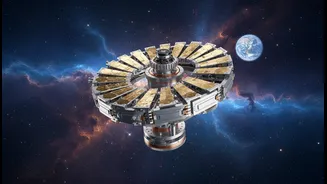


Meet the Habitable Worlds Observatory
The telescope at the center of this new approach is NASA's future Habitable Worlds Observatory (HWO). Planned for a launch in the 2040s, it's the agency's next flagship space telescope, following in the footsteps of Hubble and the James Webb Space Telescope
(JWST). Its primary mission is groundbreaking: to directly image and study rocky, Earth-like planets orbiting stars similar to our sun. The ultimate goal is to scan their atmospheres for biosignatures—chemical signs like oxygen, methane, and ozone that could indicate the presence of life. Unlike its predecessors, HWO is being designed from day one with a game-changing feature: it will be fully serviceable.
Learning from Hubble, and Webb
The Hubble Space Telescope was famously serviced by astronauts on multiple Space Shuttle missions. This ability to repair and upgrade the observatory in low-Earth orbit dramatically extended its life and scientific power. In contrast, the James Webb Space Telescope was sent to its operational post at the second Lagrange point (L2), roughly 1.5 million kilometres from Earth, with no plans for servicing. The immense distance made astronaut missions unfeasible. HWO is also destined for the distant L2 point, but NASA is taking a different approach. Shawn Domagal-Goldman, NASA's astrophysics division director, confirmed at a recent American Astronomical Society meeting that servicing the new observatory is now considered an essential part of the mission plan.
Enter the Robot Mechanics
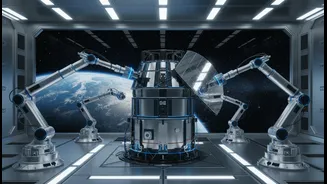
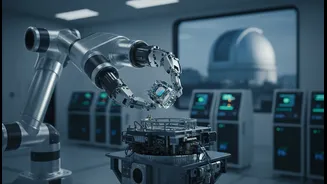
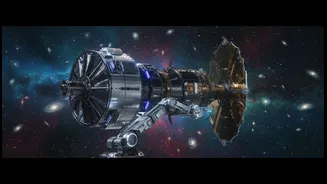
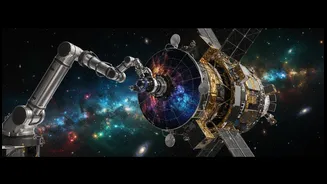
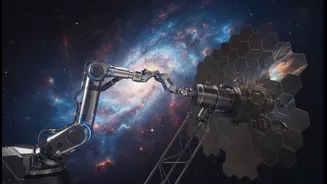
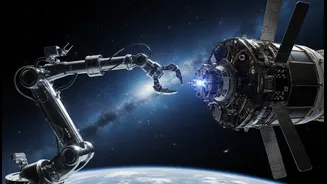
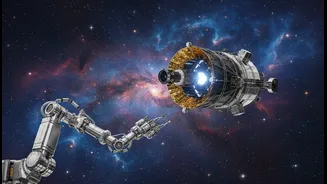
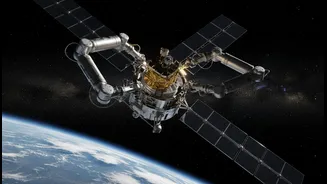
So, how do you fix a telescope 1.5 million kilometres away? The answer is with robots. NASA envisions a future where advanced robotic spacecraft will be able to perform complex maintenance tasks that were once the domain of human astronauts. The HWO will be built with a modular design, featuring standardized, line-replaceable units (LRUs) for all critical systems, from computers to scientific instruments. This means a robotic servicer could dock with the observatory, swap out an aging sensor for a next-generation one, or even patch damage from micrometeoroid impacts. This approach not only extends the telescope's operational life but also makes it future-proof, allowing for technology upgrades decades after its initial launch.
Assembling in the Void
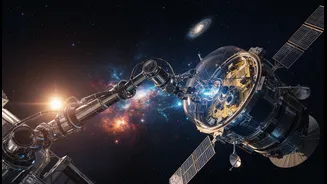
The reliance on robotics might even start before the telescope takes its first picture. One of the major challenges for HWO is its sheer scale. To find and analyze Earth-like planets, it will need a massive primary mirror, potentially larger than what can fit inside any existing rocket fairing. The solution? In-space assembly. NASA is exploring the possibility of launching the mirror segments and other components separately and using robotic servicers to put the telescope together directly in orbit. This would be by far the most challenging observatory ever built, requiring unprecedented precision and autonomy from its robotic construction crew.
A New Era for Cosmic Discovery
This shift to a serviceable, upgradable architecture represents a profound change in philosophy for NASA's flagship missions. Instead of being static, single-lifecycle assets, future great observatories like HWO will be treated as long-term orbital platforms. This ensures that our most powerful tools in the search for life beyond Earth can be maintained and improved for generations. While the specifics of the robotic servicers are still being developed, the commitment to serviceability fundamentally boosts the potential scientific return. It means the hunt for alien worlds won't be cut short by a single point of failure, but can continue, adapt, and evolve as our own technology does the same.