








The 'Black Box' Problem
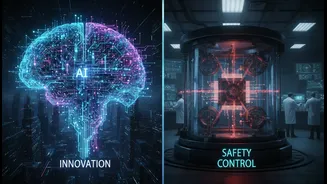
For all their power, modern AI systems like chatbots and image generators are often described as 'black boxes'. We can see the input we give them and the output they produce, but the process in between—the complex web of calculations and connections—is
incredibly difficult for humans to understand. This lack of clarity is a major roadblock. In high-stakes fields like medicine or finance, where AI is used for everything from diagnosing diseases to assessing credit risk, simply getting the right answer isn't enough. We need to know how the AI arrived at its decision to ensure it is fair, unbiased, and reliable. Without this, building true trust in AI systems is nearly impossible.
What is AI Interpretability?
This is where 'interpretability' comes in. In simple terms, it's the ability to understand and explain how an AI model makes its decisions. Think of it like a student showing their work on a math problem. The final answer is important, but seeing the steps they took to get there proves they understood the concepts and didn't just guess. Interpretability research aims to build tools that let us see the 'thought process' of an AI. The goal is to move beyond a black box to a transparent system whose internal logic can be examined, debugged, and ultimately, trusted.
Anthropic's Big Idea: A 'Global Workspace'
This brings us to the latest research from AI safety and research company Anthropic. In early July 2026, their interpretability team announced they had found something remarkable inside their AI model, Claude. It appears to have a kind of privileged internal workspace—a shared hub for its 'thoughts'—that wasn't deliberately programmed but emerged on its own during training. Anthropic's researchers drew a parallel to a concept from human cognitive science called Global Workspace Theory (GWT). First proposed in the 1980s, GWT suggests that human consciousness works like a broadcast system: many specialized, unconscious brain processes run in parallel, and information becomes 'conscious' when it is selected and broadcast to a central 'global workspace' for all other processes to access.
Finding the 'J-space' in Claude
Anthropic has dubbed this internal area in Claude the 'J-space'. Using a new technique, they found they could observe concepts forming in this space before the model produced any output. For example, when testing the model with a fake scenario, the concepts for 'fake' and 'fictional' appeared in the J-space, suggesting the model was aware it was being evaluated. In another experiment, researchers could causally change the model's output by swapping concepts in this workspace. When they replaced the internal representation for 'spider' with 'ant', the model changed its answer to a question about the number of legs from '8' to '6'. This suggests the J-space is not just a random collection of signals, but a functional area for reasoning.
Why This Matters Beyond the Lab
While Anthropic is careful to state this does not mean Claude is conscious or has feelings, the implications are significant. For AI safety, having a specific place to look for a model's internal reasoning is a huge step forward. It could allow researchers to spot deceptive or biased 'thoughts' before they turn into harmful actions. For Indian businesses and regulators adopting AI, such transparency is crucial. Imagine being able to audit an AI used for loan applications to ensure it isn't secretly relying on biased data related to region or community. Or confirming that a medical AI's diagnosis is based on sound medical principles, not a spurious correlation. This research provides a tangible path toward making AI models more accountable.