







Japan's ambitious mission to the Martian moons just cleared its first major hurdle. The MMX spacecraft has passed its initial post-launch health checks, a crucial step on its five-year journey to solve a major planetary mystery.
A New Chapter in Mars Exploration
The Japan Aerospace Exploration
Agency (JAXA) has embarked on one of the most audacious space missions of the decade: the Martian Moons eXploration, or MMX. Launched successfully on October 20, 2026, the spacecraft is now on its way to the Red Planet. Just days after leaving Earth, JAXA confirmed the mission had completed its 'initial critical operations phase'. This means the spacecraft successfully deployed its solar panels for power, established stable three-axis control to orient itself, and readied its communication antennas, confirming the probe is healthy and ready for its long journey. The MMX mission follows in the footsteps of JAXA's highly successful Hayabusa missions, which returned samples from asteroids, but it ups the ante considerably by travelling all the way to Mars for the first-ever sample return from one of its moons.
The Mysteries of Phobos and Deimos
Mars has two small, potato-shaped moons named Phobos and Deimos, but scientists are deeply divided on how they got there. This is the central question the MMX mission aims to answer. One theory, the 'captured asteroid' hypothesis, suggests the moons are ancient space rocks that strayed too close to Mars and were snagged by its gravity. If true, studying them could reveal secrets about the raw materials of the early solar system. The competing 'giant impact' theory posits that a massive object crashed into a young Mars, and Phobos and Deimos formed from the ejected debris, much like our own Moon. In this scenario, the moons would be made of ancient Martian crust, offering a snapshot of the planet's distant past, a time when it may have been more hospitable to life. By collecting a sample, MMX could finally provide the evidence needed to solve this long-standing debate.
A Complex and Daring Plan
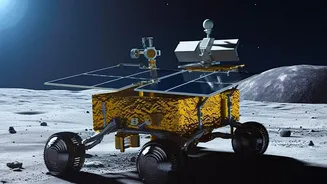
The five-year mission plan is a marvel of complex orbital mechanics and robotics. After a year-long journey, MMX will arrive at Mars in August 2027. Instead of orbiting the planet itself, it will enter a special 'Quasi-Satellite Orbit' that keeps it close to Phobos. From this vantage point, it will spend years meticulously studying both moons. It will map Phobos in detail to find the perfect landing spot. The mission also includes a small, 25-kilogram rover named IDEFIX, built by the French and German space agencies, which will be deployed to the surface first to scout the terrain for several months. Based on these observations, the main MMX spacecraft will descend and land on Phobos not once, but twice, to collect at least 10 grams of regolith, or surface soil. It will even make several fly-by observations of the smaller moon, Deimos, before beginning its journey home.
More Than Just Moon Rocks
While solving the moons' origin is the primary goal, the samples MMX brings back could hold even more profound discoveries. Because Phobos is so close to Mars, its surface is thought to be covered in dust and debris blasted off the Red Planet by asteroid impacts over billions of years. Scientists estimate that the collected sample could contain a small but significant amount of Martian material. This makes MMX a sort of 'two-for-one' mission; a back door way to get a sample from Mars without the immense challenge and cost of landing on the planet's surface and launching back off. These Martian fragments could provide invaluable information about the planet's geology and perhaps even its potential for past life. Furthermore, successfully completing a round trip mission to the Martian system will test and prove critical technologies needed for future exploration, including potential human missions where Phobos could serve as a forward operating base.