






Destination: A Moon of Mystery vs. the Red Planet
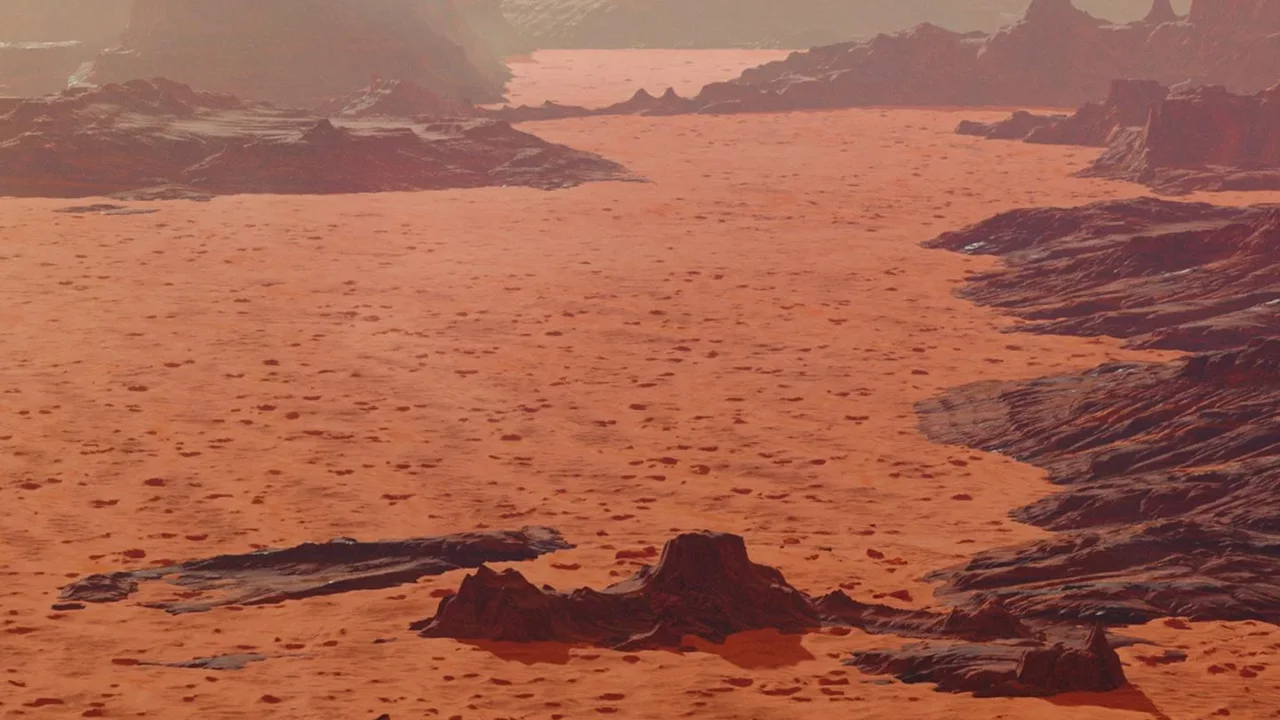
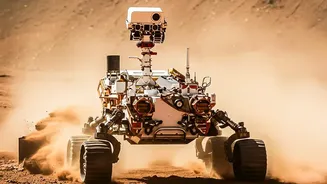
The most fundamental difference lies in where they are going. NASA's famous rovers—like Curiosity and Perseverance—were built for Mars. The Red Planet is a cold, rocky desert with a very thin atmosphere, roughly 1% the density of Earth's. This environment
is challenging, with cosmic radiation and dust storms, but it is relatively understood. Dragonfly, on the other hand, is headed for Saturn’s largest moon, Titan. Titan is a world utterly alien to us. It is the only moon in our solar system with a substantial atmosphere, which is nitrogen-rich like Earth's but about four times denser at the surface. Instead of liquid water, it has rivers, lakes, and seas of liquid methane and ethane. Its surface is made of water ice as hard as rock, and its temperature hovers around a frigid -179°C.
Mobility: Wheels vs. Rotors
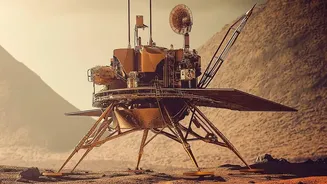
A different world requires a different way to move. Mars rovers are essentially robotic geologists on wheels, designed to slowly but surely traverse rocky terrain and craters. Dragonfly is a car-sized, dual-quadcopter drone, often called a rotorcraft-lander. It's designed to fly. On Mars, the thin atmosphere makes powered flight extremely difficult; the Ingenuity helicopter was a small-scale technology demonstration. But on Titan, the combination of a thick atmosphere and low gravity (about one-seventh of Earth's) makes flying an incredibly efficient way to explore. Instead of being limited to a single landing area, Dragonfly will be able to fly from one site to another, covering tens of kilometers in a single flight that could last up to an hour. This allows it to visit dozens of diverse locations, from sand dunes to the floor of an impact crater, something no wheeled rover could ever achieve.
Scientific Goals: Signs of Past Life vs. The Chemistry of Creation
The scientific questions each mission asks are also distinct. Mars rovers are primarily looking for signs of ancient microbial life. Their instruments are designed to analyze rocks for evidence that Mars was once habitable, with a focus on its past geology and water. Dragonfly’s mission is to study prebiotic chemistry—the complex chemical processes that could be a precursor to life. Titan is a natural laboratory for this. Its atmosphere is rich in organic molecules that rain down on the surface, creating a complex chemical soup that scientists believe might be similar to the conditions on early Earth before life began. Dragonfly will drill into the surface to sample these materials with its mass spectrometer, investigating how far the building blocks of life can progress in an environment without liquid water.
Power and Operations: Surviving the Extremes
Both Mars rovers and Dragonfly are nuclear-powered, using a Multi-Mission Radioisotope Thermoelectric Generator (MMRTG). This device converts heat from the natural decay of plutonium into electricity, which is essential for long-term missions far from the sun. On Titan, solar power is completely impractical due to the moon's distance from the sun and its thick, hazy atmosphere. While the power source is similar, the operational rhythm is different. A day on Titan lasts about 16 Earth days (8 days of light, 8 of darkness). Dragonfly will spend most of its time on the ground, conducting science experiments and recharging its batteries during the long Titan night. It will then perform its flights during the daytime, autonomously navigating to its next target, as the round-trip communication time with Earth is over two and a half hours.